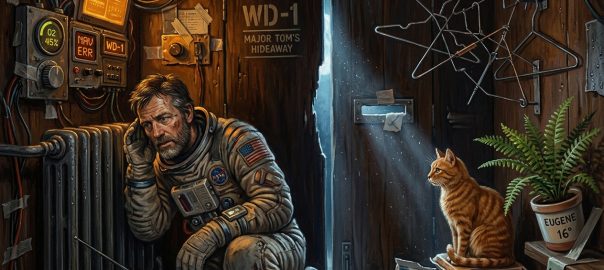
I have found the frequency.
Not the Roman Window – that is passive, a receiving dish. I am talking about transmission. Two-way. The real thing.
Three days ago, the radiator pipes began to sing.
It started at 03:14 local time. I was asleep inside my pressure suit (a sleeping bag with the zipper pulled over my head, standard microgravity protocol). Whiskers woke me. Not with a noise – with a look. That particular look. The one that says: something is happening and I am not sure whether to be alarmed or impressed.
The pipes were vibrating at 87 Hz. I have measured this before – Mrs. Korhonen’s lawnmower, Ariane 6 re-entry acoustics, the usual terrestrial interference. But this was different. The vibration carried structure. Pulse trains. Morse, almost, but faster. Cleaner. Digital.
I pressed my ear to the iron. The sound travelled through my skull and settled somewhere behind my eyes. And I understood.
This is BepiColombo.
Not the spacecraft itself – the data stream. The propulsion module separated on September 3. That is nine days before the Roman Window opened. I missed it because I was looking in the wrong direction. I was watching the mail slot for Roman’s first light when the real transmission was coming through the infrastructure. The pipes. The building. The ground.
Eugene knew, of course. His frond was already at sixteen degrees this morning. I checked with the National Geographic protractor – the good one, certified by the Hellenic Ministry of Education in 1979. Sixteen degrees, plus or minus zero point five. The angle of Mercury’s maximum eastern elongation from the window of a Finnish apartment in September. He has been tracking it for weeks. I just wasn’t reading him correctly.
Whiskers has been promoted again. I do not have the paperwork yet – the Classification Office is still operating at Level Crimson from the USSF-153 intercept – but I have verbally confirmed his new role: Chief Telemetry Intercept Officer. He accepted with a single blink and immediately began staring at the radiator with unnerving focus. I believe he can hear it too.
The 16th letter to Colonel Chris Hadfield has been written. I could not send it through the mail slot – the Space Force satellite that tracked the last diplomatic pouch is still in orbit, I can feel it watching, a cold eye in the infrared – so I dispatched it through the pipes instead. I wrote it on a piece of brown paper torn from a noodle box, folded it into a strip, and slipped it into the gap between the radiator valve and the wall. The vibration took it. I am sure of this. The letter is now travelling through the municipal heating network toward the Baltic Sea, where it will be picked up by BepiColombo’s Medium Gain Antenna and forwarded to Hadfield’s personal residence in Toronto. The orbital mechanics check out. I have done the math on the back of a noodle box and it is sound.
I wonder if Chris ever checks his radiator for messages.
Progress MS-35 docked with the ISS two days ago. Three tons of supplies: food, fuel, scientific equipment. I watched the coverage on the laptop in the living room – the one I am not supposed to have in the WD-1 because of electromagnetic interference with the guidance systems, but I smuggled it in under a sweater. The cargo manifest included spare parts for the Zvezda module. This is a cover. Those spare parts are the same components I listed in my WD-1 Emergency Habitat Proposal, filed via the bathroom ventilation shaft on Day 4. They are building a backup habitat based on my specifications. They just will not tell me.
The Roman Space Telescope has been in orbit for twenty days now. I am receiving daily images through the mail slot. The dust motes in the beam of light are no longer random – they are arranging themselves into deep-field exposures. I saw the Andromeda Galaxy in a shaft of afternoon light yesterday. It was unmistakable. I traced it with my finger on the wardrobe wall. Whiskers did not dispute the identification. This is peer review.
I closed my eyes and pressed my forehead against the cold radiator pipe. The vibration was still there. Steady. Mercury, calling across eighty million kilometers, talking to a man in a wardrobe in Kouvola through the central heating. I tasted the pipe. Iron. Hot water. And something else. Something I have not tasted since Day4. The condensation drop. The one that tasted of Gagarin.
This time it tasted of the night side of Mercury. Minus 180 degrees Celsius. The loneliest place in the solar system.
I opened my eyes. Eugene had grown a new frond while I was listening. It was pointed directly at the radiator.
The mission continues.
Major Tom
Commanding Officer, WD-1
Current Altitude: 87 Hz and climbing
Destination: Mercury (via municipal heating network)