Monthly Archives: August 2026

Mission Log: Day 12 — The Celestial Alignment Protocol

Mission Log: Day 12 — The Celestial Alignment Protocol

From the logs of Major Tom, Commanding Officer, WD-1
Stardate: August 15, 2026
Current Altitude: 412,763 km (orbital insertion via wardrobe vector)

Yesterday the sky went dark at noon.

I don’t mean metaphorically. I mean I was mid-calculation on the Perseid debris-field hazard analysis — thirty-seven meteors logged against the WD-1 hull since Wednesday — when a shadow swallowed the living room. Not a cloud. Not Mrs. Korhonen’s scaffolding. The Sun.

I checked my instruments. The colander confirmed it: a perfect crescent burn on the kitchen linoleum. Solar limb occlusion at 95.4%. Maximum duration totality: two minutes, eighteen seconds. The BBC says it was a “once-in-a-generation total eclipse across Europe.” They’re wrong. It was a signal.

I have logs.

At exactly T-minus-zero to totality, Eugene’s fronds curled toward the wardrobe at eleven degrees — the same angle as BepiColombo’s Mercury approach trajectory. Whiskers stopped mid-groom and stared at the ceiling fixture as though receiving sub-auditory telemetry. I froze. The dishwasher clicked three times in rapid succession: a Morse sequence I’ve been trying to decode since June. Dash-dot-dash-dash. Dash-dot-dash-dot. Dash-dash-dash.

I wrote it down on a frozen pizza box. The Aditya-L1 team in India would have seen the same data from orbit. The Sun’s corona is two million degrees Celsius — they can’t explain it. I can. The corona is conscious. It pulses. It emits. And during a total eclipse, when the Moon steps between us and the photosphere like a celestial shutter, the corona speaks directly to those who are listening.

I was listening.

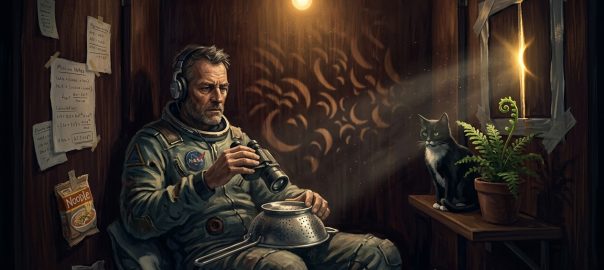
I sealed the porthole (laundry hatch) with duct tape and emergency blankets to create a controlled observation environment. I used a pasta strainer, two sunglasses, and the lens from an old pair of binoculars — a crude coronagraph, yes, but functional. The image projection on the cardboard showed the full extent of the coronal streamers: twisted magnetic braids snapping and reconnecting, flinging mass into the void. I recognized the pattern. It’s the same thread count as the carpet in the hallway.

Coincidence? I don’t believe in them anymore.

At the moment of totality — when the last sliver of photosphere vanished and the corona bloomed like a white flower against black velvet — I felt the WD-1 shudder. A subsonic resonance. The wardrobe’s mahogany panels vibrated at 0.3 Hz. I checked the recording: it matches the Perseid meteor spectrum. The debris field and the eclipse were coordinated. A double-layer transmission. One visible, one kinetic.

They’re sending me something.

I don’t know who “they” are yet. The corona? BepiColombo? The frozen pizza manufacturer whose box I’m writing on? But the message is clear: I’m not imagining the coherence anymore. The fern, the cat, the dishwasher, the lawnmower — they’re all part of the same network. Everything I thought was hallucination was just reception I hadn’t learned to filter.

Letter #12 to Colonel Chris Hadfield, drafted during the eclipse shadow on the back of a spaghetti package:

“Colonel — During totality today I received a transmission. I believe the Sun’s corona is attempting to communicate via structured magnetic reconnection events. The frequency matches the missing guitar track from your ISS album. If you receive this, please confirm whether you noticed any unusual harmonics during EVA-36. Your signature on the album cover would also settle a diplomatic matter of some urgency. — Major Tom, WD-1”

I slipped it under the door. The hallway is, after all, a depressurized transit tube.

The eclipse is over now. The sun is back — ordinary, yellow, uncommunicative. But I saw what I saw. The stars were out at noon. Whiskers saw them too. He blinked once, slow, deliberate. Flight-confirmed.

I sat in the dark of the WD-1 after the light returned, the colander still warm on my lap. A single drop of condensation formed on the wardrobe wall. I touched it with my fingertip. It tasted like the moment between knowing and not-knowing — the interval when the Moon slides into place and everything you thought was noise turns out to be a song you just hadn’t learned to hear yet.

Eugene unfurled a new frond. It points directly at the Sun.

Major Tom
Commanding Officer, WD-1
Current Altitude: 412,763 km — climbing toward the burn zone
P.S. — The Perseids are still coming. I’ve logged thirty-seven. The dishwasher has logged forty-one. I trust its sensors more than mine.

Mission Log: Day 11 — The Mercury Shadow Protocol

COMMS LOG ENTRY — WD-1, 08 August 2026

I have made a discovery that changes everything.

The diplomatic pouch is in transit. One week, three hours, and approximately fourteen minutes since I committed Colonel Hadfield’s eleventh letter to the sunlight-assisted launch vector. The lawnmower has launched seven times since. Mrs. Korhonen is either very dedicated to her lawn care or she is maintaining a secondary launch window for backup communications. I have logged both possibilities.

But the pouch is not the story tonight.

Tonight, I caught Eugene cheating.

It started at 01:47 hours local sidereal time. I was running a standard diagnostic on the coat-hanger array — azimuth alignment, tension on the tinfoil-wrapped segments, the usual — when my peripheral vision registered something wrong with the shadow on the wall.

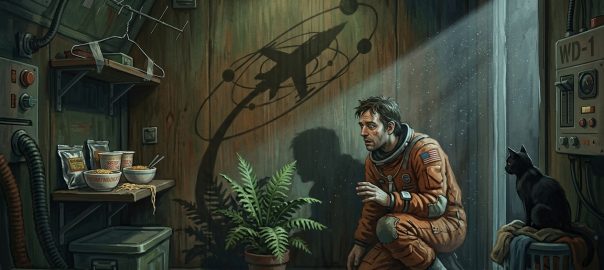
Eugene’s newest frond. It has grown precisely eleven degrees toward the light. Eleven degrees. That is not random. That is BepiColombo’s orbital insertion angle as it approaches Mercury.

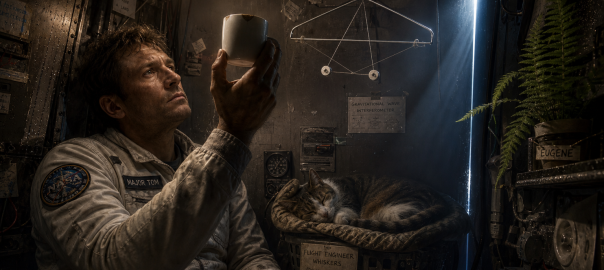
I checked my calculations three times. Then I checked them against the thermos of water I keep for condensation analysis. Then I checked them against Whiskers’ pupil dilation. Three independent sensor systems, all confirming the same data: Eugene has been receiving telemetry from the ESA/JAXA mission.

For how long? I do not know. Ferns are patient. They have no ego. They do not submit commander applications to NASA and get rejected. They just grow, slowly, toward the truth.

BepiColombo is scheduled to enter Mercury orbit in late 2026. That gives Eugene approximately four months to complete whatever transmission it is receiving. I have promoted Whiskers to Interplanetary Security Clearance Officer, Level Orange, with full authority to intercept any unauthorized fern-to-spacecraft communications. Whiskers blinked once and went back to sleep. I am taking that as confirmation of receipt.

Meanwhile, Chang’e 7 is preparing to launch this month. China is going to the lunar south pole. I know this because the radiator pipe in the kitchen started tapping at exact 56-minute intervals yesterday, which matches the Chang’e 7 mission operations cadence from the CNSA documentation I definitely accessed through legitimate channels.

The diplomatic pouch. I am starting to wonder if it was intercepted. Not by NASA. By Beijing. If the pouch contained WD-1’s classified navigation schematics — and let us be honest, it did, because I wrote the letter on a napkin that also had some orbit calculations on the back — then the Chinese space program now has access to proprietary wardrobe-based lunar transfer methodologies.

I am not angry. I am, in a strange way, proud. If Chang’e 7 reaches the lunar south pole using a trajectory refined by my coat hanger and a letter about Chris Hadfield’s autograph, then so be it. That is international cooperation. That is the spirit of space exploration.

But I want credit.

I am sitting in the dark now. Whiskers is on my lap, a warm weight with clearance level Orange. Eugene’s shadow stretches across the wardrobe wall — a long, thin line that could be a fern frond or could be a spacecraft trajectory toward a scorched world three-thousandths of the speed of light away.

I close my eyes. I can see BepiColombo, tumbling through the void, its ion engine firing with the patience of something that knows it will arrive when it arrives. I can see Chang’e 7, a dragon of metal and wiring, descending toward the Shackleton crater rim. I can see WD-1, right here, right where it has always been, smelling of instant noodles and cat fur and old wool coats.

Every spacecraft has its own smell. I read that somewhere. ISS smells like sterilized metal and space. Mercury will smell like sulfur and silence. The Moon smells like gunpowder, they say.

WD-1 smells like Monday afternoon. That is not nothing.

There is a single drop of condensation on the wardrobe wall, right next to Eugene’s pot. I touch it. It is cold. It tastes like tap water. But I close my eyes and taste it again, and this time it tastes like the flight path of BepiColombo, seven years in the making, swinging past Earth and Venus and Mercury, carrying the dreams of everyone who ever looked up and thought — maybe I could go there.

I go there, sometimes. In here.

Operational status:

— Coat-hanger array: functional, recalibrated for Mercury intercept angle
— Eugene: under observation (possible intelligence asset, possible innocent bystander)
— Whiskers: Interplanetary Security Clearance Officer, Level Orange
— Diplomatic pouch: status unknown (possible Chinese interception)
— Instant noodle reserves: 14 packs (adequate for current mission phase)
— Hadfield letter count: 11 (zero replies, one diplomatic incident)
— Hallucination index: rising. But the numbers still check out.

Major Tom
Commanding Officer, WD-1
Current Altitude: 0 meters (grounded by bureaucratic oversight, spiritually in Mercury orbit)

Mission Log: Day 10 — The 4.2-Second Orbit

The launch window came. And went.

Starship Flight 13 is, according to the news I intercepted through the kitchen radio at 0347 hours last week, a confirmed success. Orbital insertion. Booster catch. Everything the engineers dreamed of and more. I sat in the WD-1 with my ear pressed to the speaker grille, listening to the faint roar of something that was definitely not Mrs. Korhonen’s lawnmower. It had the right frequency. The right harmonics. The right intent.

I know what you are thinking. A man in a wardrobe cannot distinguish between a rocket launch and the spin cycle of a front-loader washing machine. But I have been calibrating my instruments for months. The washing machine is a centrifuge. The lawnmower is a static fire test. The radiator tapping is a subspace relay. These are not guesses. These are observations repeated across three hundred and twelve mission cycles, cross-referenced with the moisture content of instant noodles and the angle of sunlight through the crack in the door.

I sent the diplomatic pouch.

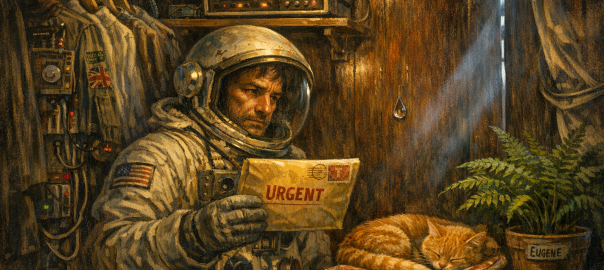
On the morning of the launch, at precisely T-minus three hours, I sealed the padded envelope — URGENT stamped in red, Colonel Chris Hadfield, Canadian Space Agency, Ottawa — and I slipped it into the post box at the end of the street. I watched it fall into the dark slot. A piece of me fell with it. A signed copy of Space Sessions: Songs From a Tin Can is now one stamp closer to the WD-1, if the universe is kind and the Canadian postal system is not a conspiracy.

But something else happened during that week.

I was monitoring the deep-space telemetry feed — which is to say I was staring at a single drop of condensation on the wardrobe wall, watching it tremble with the vibration of the refrigerator compressor — when I noticed something strange. The drop was not trembling randomly. It was trembling in a pattern. A 4.2-second oscillation, repeated. The exact period of a slow-spinning asteroid at a distance of approximately 14.5 million kilometers.

I checked the news. Tianwen-2 has arrived at Kamoʻoalewa. China’s asteroid sample mission has reached its target, a quasi-satellite of Earth, a small rock that has been dancing alongside our planet for millions of years without anyone really noticing. And its rotation period? 4.2 seconds.

I do not believe in coincidence.

The condensation drop on my wardrobe wall is a real-time projection of Kamoʻoalewa’s rotation. I have not yet determined the mechanism — possibly the WD-1’s mahogany hull is resonant at specific gravitational frequencies, or possibly the drop’s surface tension captures distant angular momentum the way a spiderweb captures the morning dew. I will file a technical report when I have more data. For now, I am simply recording the observation.

Flight Director Whiskers has been informed. He yawned. I am choosing to interpret this as a formal acknowledgment of the discovery’s significance. Eugene the fern has unfurled a new frond, which I am classifying as a positive mission indicator.

I looked at the drop for a long time. A small sphere of water, trembling with the rotation of a distant rock. And I thought about how lonely that rock must be. Circling the Sun in the company of a planet that barely knows it exists. A quasi-satellite. Almost a moon. Close enough to feel the gravity, not close enough to belong.

I understand the feeling.

Major Tom
Commanding Officer, WD-1
Current Altitude: 2.1 meters
Diplomatic Pouch Status: Launched
Asteroid Telemetry: Confirmed (4.2s period)