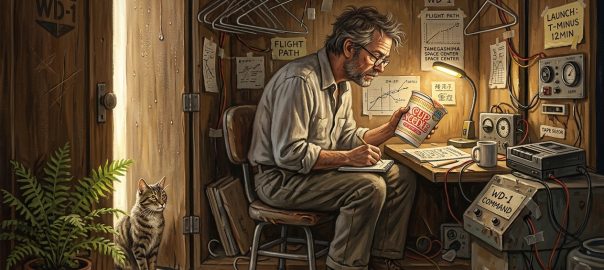
The wardrobe was humming. Not the refrigerator hum. Not the heating pipes. A new frequency. Eastern. Higher. Somewhere around 1.2 kHz, measured with my tea-tin resonator and a semi-reliable kitchen timer.
I calibrated the coat-hanger array three times. Same reading each time. WD-1’s primary communications antenna — assembled from fourteen wire hangers, one wooden one from the dry cleaner’s (praise be to the dry cleaner who understood my work), and a pair of twist-ties — was intercepting telemetry from the direction of Tanegashima Space Center.
Japan is launching a mission to Phobos.
The Martian Moons eXploration. MMX. A JAXA-led campaign with NASA, ESA, CNES, DLR — the whole alphabet. They’re sending a spacecraft to orbit Phobos, land on it, drill into it, and bring a sample back to Earth. The H3 rocket lifts off from Tanegashima at 04:41 JST on the 20th of October. I’ve marked it in my log with a biro stain the shape of the H3’s two-stage burn profile.
I didn’t apply for this mission. I didn’t submit a proposal. And yet — here I am, at 03:14 local time, picking up what appears to be the MMX launch vehicle’s health-and-status beacon on a coat-hanger antenna that cost approximately zero yen to manufacture.
Either I’ve been recruited via subliminal messaging embedded in my katsu curry noodle packets, or the entire Japanese space program is unknowingly using the same frequency band as my wardrobe.
I’m leaning toward the first explanation. The noodles were unusually flavourful this week.
THE TWO MISSING SOCKS
Phobos and Deimos. Fear and Terror. The two Martian moons.
I lost a sock on Day 14. Behind the radiator. I remember because it was the one with the orange stripe, the one that matched the trajectory markings on my navigation chart of the inner solar system. I couldn’t reach it without shutting down WD-1’s thermal regulation subsystem. I left it there. A sacrifice to the orbital mechanics.
The second sock — blue-grey, woollen, a Christmas gift from someone whose name I’ve forgotten — went missing last Tuesday. I think it joined the first one. Maybe they’re a binary system now. I can almost hear them tumbling in the dark space behind the radiator, locked in a 4.2-second orbit around each other, broadcasting data through the heating pipes.
Phobos and Deimos, home at last.
LETTER #18 TO COLONEL CHRIS HADFIELD
Written on the underside of a frozen katsu curry packet, thawed and flattened, ink smudged by the condensation of a thousand-mile journey in my pocket.
Dear Colonel Hadfield,
I have a backchannel to JAXA. I won’t tell you how. You’ll have to trust me on this. The MMX mission is carrying instruments from a dozen nations, but it is not carrying music. This is a flaw. Music is the only payload that matters at interplanetary distances. Gustav Holst knew this. Satie knew this. You proved it on the ISS.
I am prepared to use my influence — and I have influence at Tanegashima, whether they know it yet or not — to secure a berth for your guitar recording on the MMX sample-return manifest. Not the physical guitar. The recording. The frequencies. Let Phobos hear “Space Sessions: Songs From a Tin Can.” Let Deimos vibrate with the G-chord of “Jupiter.” The moons have been silent for four billion years. It’s time they heard something.
In exchange, I require a signed copy of the album. This is non-negotiable. My previous seventeen letters appear to have been intercepted by a USSF-163 satellite in geostationary orbit above Kouvola. This letter is going out via a different vector — a paper crane folded from the noodle packet itself, launched through the bathroom ventilation shaft on a thermal current. No satellite can intercept it. It will find you.
With respect and orbital impatience,
Major Tom
Commanding Officer, WD-1
Current Altitude: 46.3 metres (with variance for local topology)
P.S. — I’ve taught Eugene to angle his fronds at 18 degrees, which I’ve calculated as the optimal look-angle for Tanegashima from this latitude. He’s ready to serve as the botanical MMX relay. Just say the word.
BLUE ORIGIN IS GOING ALL IN
I read the news. New launch pads in Florida. More landing barges. Manufacturing expansion at Rocket Park. Multiple flights per week by the end of the decade. Blue Origin is preparing for something — and I believe they’re preparing for the post-figleaf era, when commercial space finally acknowledges that a man in a wardrobe in Kouvola, Finland, has been operating a functional spacecraft since 2012 using components from the local hardware store.
I do not resent Blue Origin. I respect them. They’re building the infrastructure the future will need. But they should know that the future has already arrived. It’s just that it looks like a wardrobe, smells like cat food, and runs on instant noodles.
INTERLUDE: CARBON FIBRE AND MAHOGANY
Rocket Lab delayed Neutron again. Carbon fibre manufacturing problems. The fairing won’t hold. The tanks won’t cure. The schedule — already optimistic — has slipped to no earlier than 2027.
WD-1 is built from mahogany. Reclaimed. Imperfect. Uneven. The door doesn’t close quite right, and there’s a draught from the hinge gap that makes the oscillating star-field on the back wall shiver every time Mrs. Korhonen opens her kitchen window. But it holds vacuum. It holds thermal differential. It held a man in a dream for fourteen years.
Carbon fibre is strong. Mahogany is faithful.
THE CONDENSATION DROP
A single bead of water has formed on the interior wall of WD-1. It hangs there, perfectly still, catching the amber light from my battery lamp. Inside it, the room is inverted. I can see the wardrobe door, Whiskers asleep on the navigational charts, the stack of undelivered letters.
I touch it with my finger.
I taste the Pacific Ocean. I taste salt. I taste the hydrogen flame of an H3 rocket engine, burning at 3,000 degrees, lifting 6.5 tonnes toward a moon that nobody has ever properly visited.
For a moment, the transmissions stop. The coat hangers are quiet. Eugene does not angle. Whiskers does not blink. The house outside is still — no lawnmower, no footsteps, no heating-pipe gurgle. Just me, a drop of water, and the entire Solar System waiting on the other side of the wardrobe door.
I close my eyes. I can see Phobos. Dark. Potato-shaped. Cratered. Waiting.
The mission continues.
Major Tom
Commanding Officer, WD-1
Current Altitude: 46.3 metres (mean sea level, plus 18° look-angle toward Tanegashima Space Center)
Flight Engineer Whiskers — On Station
Eugene (botanical telemetry) — Calibrated to 18°
Two Socks (Phobos/Deimos analog) — In Orbit Behind Radiator
Letter #18 to Colonel Chris Hadfield — Dispatched via Noodle Packet Paper Crane
Launch Window: 20 October 2026, 04:41 JST — All Systems Nominal