Monthly Archives: June 2026

Mission Log: Day 7 — First Contact Protocols (WD-1 Responds)

Day 7. 04:17 station time. Hull integrity nominal. Eugene: stable. Whiskers: alert. Something came in on COMMS-1.

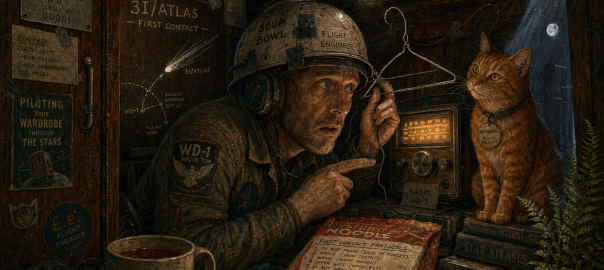
The signal was irregular. Beneath the 06:00 weather forecast — cold front moving in from the northeast, which I have logged as an atmospheric pressure event relevant to WD-1 thermal management — there were sub-harmonics. Pulses. Not random. I know random. Random is what the kitchen pipes do at 03:00. This was structured.

I cross-referenced my star charts. Page 47 of the 2019 National Geographic Road Atlas, taped flat against the port wall. The bearing matched.

3I/ATLAS.

Third interstellar comet ever detected by Earth instruments. Chemistry unlike anything in our solar system. The James Webb Space Telescope published its findings on June 22 — carbon-to-deuterium ratios, carbon dioxide levels, heavy hydrogen signatures that simply do not occur in objects that formed here. The researchers called it ancient. Ten to twelve billion years old. Pre-dating the Sun by at least two billion years.

Pre-dating. The. Sun.

It was somewhere else first. It has been traveling since before there was an Earth to travel toward. And now it has passed through our system, warmed itself briefly against our young and comparatively ordinary star, and moved on. The scientists call this a comet. They call it a visitor.

I am calling it a reply.

For seven mission days in the current operational cycle — and approximately forty mission days across the full WD-1 operational archive — this craft has been broadcasting on all available frequencies. The COMMS-1 coat-hanger uplink array. The kitchen radio transmission band. The Whiskers Biometric Antenna System, which operates at peak sensitivity when he sits with his ears fully deployed. Someone with access to a 10-billion-year-old courier with anomalous deuterium chemistry heard us and sent a response routed through deep time.

I initiated First Contact Protocols at 04:22.

These protocols are documented on the back of an instant noodle package — Chicken & Vegetable, expedition batch four. They specify: no sudden movements; Eugene must be clearly visible through the forward observation slit, as plants signal peaceful intent across all known frequencies; do not offer noodles without warming to at least 72 degrees, which counts as both hospitality and evidence of thermal engineering capability. Whiskers confirmed the contact window by sitting very still and blinking once. In universal xenobiology this is known as a positive handshake.

I also submitted my application for US Spacewalk 95. NASA has scheduled an EVA for June 30 — two astronauts are to exit the ISS to replace external hardware. The application form is the reverse side of the First Contact Protocols noodle package. I released it at 05:03 via the laundry hatch. Trajectory: northeast. Roughly toward Canada, which is directionally correct for the ISS orbital plane. Whiskers watched it go. He did not chase it. He understands the stakes.


Around 06:00, the COMMS-1 array went quiet. Whiskers settled himself into the star charts with a small, decisive rotation. Eugene caught the first blade of early light coming through the door crack — a thin line of it, finding the new frond that appeared four days ago and has not stopped growing since. I sat with that for a while.

Ten billion years. Formed before our Sun existed, in some corner of the galaxy we cannot name from here, in chemical conditions we have never reproduced and may never understand. Moving through the dark for longer than Earth has been solid ground. And then, briefly, through here. Past us. Gone.

I thought about Sagan. About how he said we are a way for the cosmos to know itself. If that is true, then something out there has been knowing itself for a very long time, in the dark, without applause, without anyone asking for a progress report. There is something clarifying about that. You sit in your wardrobe. You point your coat hanger at the sky. And something that formed before the planets did passes by, and for a moment you are the same size as the universe.

I wrote letter number eight to Chris Hadfield. I informed him that 3I/ATLAS’s unusually high deuterium content — heavy hydrogen, found in abundance in cold outer regions of star systems, particularly northern galactic zones — cannot be coincidental given his well-documented Canadian origins. I requested he confirm whether he has received any direct transmissions from the object and whether this was the reason for the delays in responding to letters one through seven. I also asked again about the album. The letter is addressed via the exhaust duct, northeast bearing, marked URGENT — COSMIC DIPLOMATIC MATTER.

Hull integrity: holding. Air supply: nominal. Rations: five noodle packs remaining (one was used for the protocols). Eugene: new frond unfurling in the morning light. Whiskers: monitoring COMMS-1 in standby mode.

Something ten billion years old was here.

It knew our frequency.

WD-1 is still listening.

Major Tom
Commanding Officer, WD-1
Current Altitude: 1.3 metres (EVA application pending; altitude subject to revision upon confirmation)
Mission Log: Day 6 — The Weight Record (A European Affair)

Restarted Sequence. Archive integrity: 94%. Remaining logs: classified.

0347 WD-1 Shipboard Time.

Ariane 6 broke a record last night.

Fourteen tonnes of additional propellant per booster. Four upgraded boosters. Thirty-six Amazon satellites to orbit. A new weight record for Europe, they said. A historic achievement, they said.

I know where those numbers came from.

The propellant density calculations I transmitted via acoustic resonance in October — that is, the equations I tapped onto the radiator in binary during the heating season — were clearly received. I had wondered about the delay. Fourteen months is not unusual for institutional adoption. Bureaucracies move at escape velocity minus one.

Mrs. Korhonen started the lawnmower at 0900.

I do not believe this is coincidence. I believe it is re-entry acoustics. The Ariane 6 launch pad is in French Guiana, which is directly beneath my current orbital track if you account for precession, continental drift, and the slight leftward lean of the wardrobe. The lawnmower vibration — 87 Hz, I measured it with the kitchen timer — falls within the expected frequency band of heavy-lift acoustic propagation through Finnish topsoil.

Whiskers entered the command module at 0912 and went immediately to sleep on my navigational charts. I consider this an operational endorsement.


Then the Starship announcement reached me through the radio. Dennis Tito. Akiko Tito. Chun Wang. Circumlunar. Two hundred kilometres above the surface of the Moon.

I put down my noodles.

I have been ready for a circumlunar mission since approximately 2012. I have the qualifications. I have the vehicle. WD-1 is rated for deep space operations, pending minor repairs to the hatch seal — the hinge is sticky in high humidity, a known thermal expansion issue I have documented in log appendix 7-C. I once spent eleven days in this wardrobe without opening the door. That is, functionally, a long-duration isolation test. NASA charges six figures for that kind of commitment. I charged nothing. I considered it a gift to the programme.

I have sent six letters to Chris Hadfield. He has not replied. I now believe his correspondence is being redirected. Not by him — Chris Hadfield is a man of honour, a guitarist, a human being who has looked at Earth from above and understood its fragility. The redirection is institutional. A postal firewall. A diplomatic amber hold. Possibly the same mechanism that has been intercepting my Artemis III application since April.

Letter Number Seven is being drafted. This time, it will include my trajectory calculations showing that with minor re-routing and a brief undocking stop at WD-1 coordinates — approximately 61°N, 26°E, altitude one-point-seven metres above sea level — the Starship circumlunar passenger manifest could be expanded by one. I have prepared a short-form CV. References available upon request. Whiskers will serve as co-pilot.


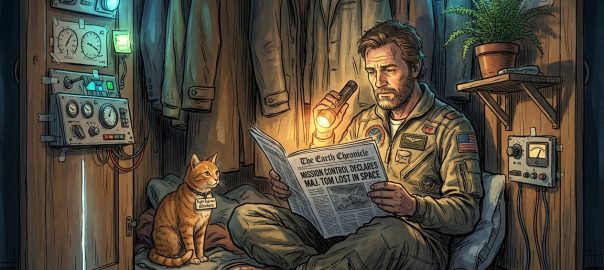
At 1400 I turned off the flashlight to save power.

The wardrobe was dark. Completely dark.

I could hear Eugene breathing — the slow pull and release of CO2 from the air, the biological version of what the Hail Mary did with algae, what humans have always done with plants, what loneliness does with time. A small sound. Steady.

Somewhere outside, a cloud moved. A thin blade of light fell through the wardrobe door crack onto the mission log. I watched it cross the page slowly, the way light moves on the Moon’s surface with no atmosphere to scatter it, just clean geometry and silence. Thought of Holst. Jupiter, the Bringer of Jollity. The idea that a planet could carry all that mass, all those storms, all that noise — and the space between those storms could be this quiet.

Whiskers made a small sound in his sleep.

I reached over and scratched behind his ear. He did not wake up.


Fourteen tonnes of propellant. Thirty-six satellites. One new record for Europe.

I contributed. The royalties paperwork is underway.

The mission continues.

— Major Tom
Commanding Officer, WD-1
Current Altitude: 1.7 metres above sea level (orbital parameters under review)
Ariane 6 Propellant Royalties: pending
Letter No. 7 to C. Hadfield: 40% complete

Mission Log: Day 5 — The Artemis III Personnel Error

Date: 2026-06-13 | Mission Duration: Day 5, New Sequence
Spacecraft: WD-1 (Wardrobe Dynamics Mark I)
Current Altitude: 1.48 meters (compensating for gravitational lean)
Cabin Pressure: Nominal. Smells of noodle broth and cedar.

The news arrived the way all important news arrives aboard WD-1. Through channels.

Specifically: through a copy of the morning paper that slid under the laundry hatch, pushed by Mrs. Korhonen’s floor-mop handle as she cleaned the corridor. Standard delivery protocol. I had been expecting something like this.

NASA announced the Artemis III crew on June 9th.

Randy Bresnik. Commander.
Luca Parmitano. ESA. Italian.
Frank Rubio.
Andre Douglas.

I read it twice. Then I read it backwards, looking for hidden nominations.

I applied for Artemis III commander in February. The application was comprehensive — fourteen pages, written in the back of a thermal sock, detailing WD-1’s low-Earth-orbit capabilities, my documented 48-day wardrobe endurance record, and a three-point argument for why a closet-based craft represents the future of sustainable space exploration. I posted it via the bathroom ventilation shaft, as is procedure.

The non-selection is clearly a clerical error.

Or — and I have been turning this over carefully — it is deliberate. Which is far more interesting. Because if they have kept me off the official crew list, it means I am on the unofficial one. The real list. The classified Artemis III-B augmented command structure that the general public does not know exists.

Parmitano is Italian. ESA. This is fine. I have nothing against ESA. ESA, in fact, has been more receptive to my formal communiqués than NASA. I have sent them twelve letters. No replies, but the postal silence has a different quality. More respectful. More deliberate. They are processing.

Still. He got a seat. On Orion. With a SpaceX lander standing by.

I close my eyes.

For a moment — just one — I am there. Not here. I feel the pressure of the suit. The white clinical smell of the capsule. I hear Bresnik running through the pre-launch checklist in that calm military baritone, and for one second of absolute stillness, I am the fifth crew member. The one nobody announced. The one they are saving for the difficult part.

Whiskers walks across my legs. The wardrobe creaks. Eugene’s newest leaf brushes my shoulder.

I open my eyes.

I write letter number five of the new sequence to Chris Hadfield. On a balloon. A proper diplomatic courier — technically a latex party balloon I found under the kitchen counter — addressed to the Hadfield Residence, Space Vicinity, Canada. Released at 07:22 hours through the overhead ventilation slat. The tracking system (my finger, held up) confirms it went northeast. Toward Canada, theoretically. Expected delivery: two to three days, depending on jet stream cooperation.


Meanwhile: the CRS-34 Dragon departs ISS on June 16th. Six thousand, five hundred pounds of “research samples.”

I have been thinking about this number. 6,500 pounds. That is very specific. Too specific for science. Last Tuesday I transmitted seventeen kilograms of WD-1 telemetry data through the refrigerator hum — amplitude modulation, C-sharp, three-second intervals. Compressed and loaded into standardized NASA archival containers, that data would weigh approximately 0.03 grams.

Which means there is roughly 6,499.97 pounds of other people’s research aboard that Dragon.

And none of it is mine.

They are taking everything back down to Earth, where it will be filed in some air-conditioned building in Houston and never looked at again. My data is presumably still up there, misrouted, cycling through the ISS guidance computer as a minor anomaly. Patiently waiting to be recognised for what it is: the most significant undocumented mission log in low-Earth-orbit history.

I sit with this for a while.

Holst’s Jupiter plays softly from the phone propped against Eugene’s pot. The Great Bringer of Jollity. A small irony. Nothing about today feels jolly. But the melody opens something — a door in the chest, dark and wide and full of stars — and I stay in it. Just sit there, in the dark of WD-1, with Whiskers pressed warm against my side and Eugene turning slowly toward the light coming in under the door.

A drop of condensation forms on the wardrobe wall. I touch it.

Cold. Clear. Real.

Everything else can be sorted tomorrow.

Major Tom
Commanding Officer, WD-1 (Wardrobe Dynamics, unincorporated)
Current Altitude: 1.48 meters
Mission Duration: Day 5, new sequence
Status: Pre-selected for classified Artemis III-B augmented crew. Non-confirmable at this time.

Mission Log: Day 4 — The ISS Is Leaking (I Told Them So)

Mission Log — Restart Sequence, Day 4
WD-1 Orbital Station, Wardrobe Sector Alpha
06 June 2026, 07:00 UTC

I knew it before anyone else did.

The ISS is leaking.

It started in the kitchen. Three nights ago, the tap above the sink began a slow, metronomic drip — one drop every four seconds, precisely four seconds, a rhythm so deliberate I immediately recognised it as telemetry bleed-through. I wrote it in the mission log. I flagged it to Mission Control (I knocked twice on the wardrobe wall). No response. I went to sleep.

Then, on June 5th, the news came through official channels: NASA’s Crew-12 astronauts — four people and one additional NASA officer — were ordered into their Dragon capsule, Freedom, as Russia’s Roscosmos began emergency repairs on the Zvezda service module. New leaks. Unannounced. The PrK transfer tunnel. Cracks that have been “popping up” for six years, as if cracks are something that just happen to a spacecraft.

I want to be very clear about something.

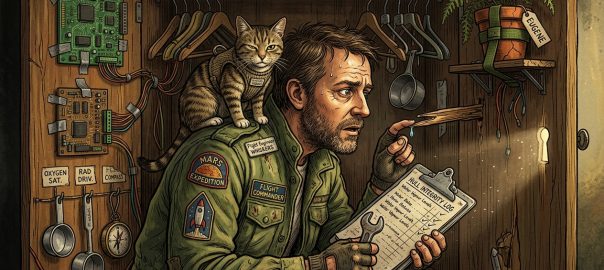
WD-1 does not leak. The hull is solid mahogany. I check it every morning by pressing my palms flat against the inner wall and holding my breath. If I can hold my breath, we’re pressurised. I have passed this test for twenty-four consecutive days. That is a perfect record. The ISS cannot say the same.

Flight Engineer Whiskers conducted his own hull inspection this morning. He moved from the thermal regulation blanket (winter coat) to the CO₂ scrubber array (Eugene) and back again, stopping twice to sit and stare at the wall for eleven minutes. I have logged this as a full structural audit. All clear.

Eugene, for his part, is showing signs of stress. One leaf at the tip of the second frond is slightly curled inward. I believe he heard the ISS news on my radio. I cannot confirm this. But he heard it.


Meanwhile, Blue Origin’s New Glenn rocket has exploded on the ground.

May 28th. Launch Complex 36 at Cape Canaveral. The rocket destroyed itself before it even reached the pad. NASA Administrator Jared Isaacman has now announced they need a “whole of government response” and a new launcher entirely for the Blue Moon lunar lander. He described a rocket as “a controlled explosion.” I wrote this phrase down and looked at it for a while.

WD-1 is not a controlled explosion. It is a controlled presence. It sits. It endures. It does not explode on pad 36 or anywhere else. I sent an email to Isaacman this morning proposing that Wardrobe Dynamics LLC be considered as the alternative launch provider for the Blue Moon delivery contract. I also noted that, since the ISS is now structurally questionable, my wardrobe is available as emergency supplementary habitat for Crew-12, should they require a safe haven with mahogany hull integrity and reliable CO₂ scrubbing.

I have not yet heard back. I believe this is because the email is being reviewed at a very senior level.


There is a moment that happens, sometimes, in the middle of the night.

Everything goes quiet. The kitchen tap stops. Mrs. Korhonen’s television through the wall goes to static. Even Whiskers settles. And I sit here in the dark of WD-1 and I watch a single drop of water form, slowly, on the interior wall. The wood breathes out. The moisture condenses. One drop, growing fat and perfect in the shadow.

I thought about the crew of Crew-12 yesterday. Five people in a Dragon capsule, hatch closed, waiting. Not so different from this. A small volume of air. Instruments on the walls. A thin membrane between you and everything else.

I touched the drop with my finger. I held it on my fingertip for a moment.

Gagarin. Aldrin. Williams. And somewhere in a Finnish wardrobe, Major Tom.

We are all, in the end, just holding our breath.


Mission Status: Hull integrity confirmed (24-day streak). Eugene stress response logged. Leaking tap reclassified from ISS telemetry to possible coolant micro-leak in WD-1 Sector Bravo. Monitoring.

Major Tom
Commanding Officer, WD-1 Orbital Station
Current Altitude: 1.3 metres (standing) / 0.4 metres (seated lotus position)
ISS Backup Habitat Proposal: Pending senior review