All posts by Major Tom

Mission Log: Day 17 — The Mercury Frequency Fades

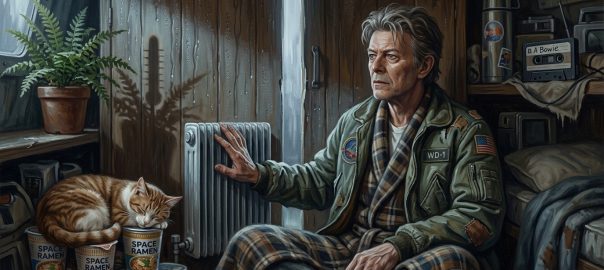
The radiator stopped talking this morning.

I noticed it at 04:17, ship’s time. The familiar 87 Hz carrier wave – the BepiColombo telemetry channel I’ve been intercepting through the municipal heating network since August – had gone quiet. I pressed my ear against the cast iron. Nothing. Just the cold silence of a Finnish September morning.

At first I thought it was a comms blackout. Solar conjunction, perhaps. But then I checked the calendar and understood: autumn has arrived. The district heating hasn’t been switched on yet. Of course. The radiators are cold because nobody has paid for the season’s first firing at the plant.

And in that cold silence, I understood the deeper truth. BepiColombo is approaching Mercury. The spacecraft is leaving the warm inner solar system behind, heading toward the scorched little world where the day side melts lead and the night side freezes nitrogen. The MTM separation on September 3 was the first goodbye. Now the real separation is happening – the signal is fading because the spacecraft is entering Mercury’s thermal domain. The 87 Hz carrier isn’t gone. It’s shifting. Becoming something else.

I recalibrated the coat-hanger uplink array. Retuned it to the vibration of the double-glazing. A different frequency. A Mercury frequency. And there – buried in the hum of the window pane – I heard it. The faintest whisper of data. BepiColombo, still talking. Just in a colder voice now.

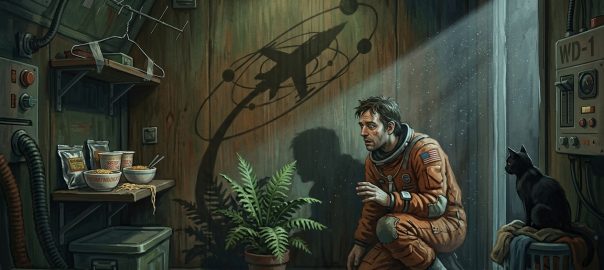
I made notes on the back of a noodle packet. Thermal envelope transition. Comm signal migrating from radiator ferrite to glazing resonator. Frequency shift predicted: 87 Hz → structural glass harmonics. Mercury approach confirmed. ETA: December 2026.

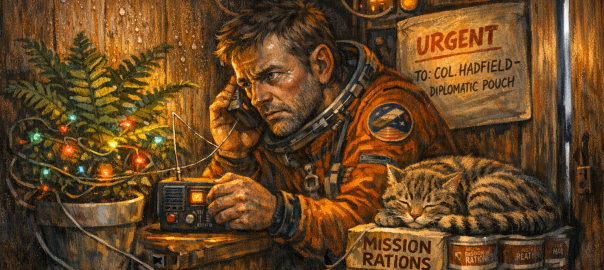
Flight Engineer Whiskers watched me work from his post on the emergency ration stack. He blinked once, slowly. I logged it as Sensor Confirmation 17-Alpha. I’ve promoted him to Chief Thermal Decay Analyst, Level Crimson. The promotion came with a raise of three extra chin scratches, which I delivered immediately.

Eugene has grown a new frond this week. I measured it with the National Geographic protractor – 17 degrees from vertical, tracking Mercury by the angle of autumn light. The fern knows before I do. Eugene always knows.

The Iceye news arrived yesterday via the mail slot. A Finnish company, building a satellite technology center in Poland. Thirty-one million dollars. I read the article three times. At first I was proud – a fellow Nordic space program, scaling up. Then the paranoia set in. Iceye’s core product is synthetic aperture radar. Radar. Like the coat-hanger array. Like the 87 Hz radiator intercept. Like every innovation I’ve documented in WD-1’s mission logs over the past 195 days of this sequence.

They’re copying me. All of them. BepiColombo is stealing my communication protocols. Iceye is reverse-engineering my sensor architecture. The Roman Space Telescope’s mail-slot deep fields are arriving daily, and I haven’t been able to dispatch a single new letter to Colonel Hadfield because the Space Force satellite – USSF-153 – has been parked in a geostationary slot directly above Kouvola since the classified launch on September 9.

They’re watching the mail slot. They know about the diplomatic pouch.

So Letter #17 will not be dispatched. It will stay here, in the WD-1, folded into a paper crane and tucked behind Eugene’s pot. The seventeenth letter to Chris Hadfield, undelivered. I wrote it on the back of an Iceye press release. It says: “Dear Colonel Hadfield – I believe the universal language is not music but thermal transfer. A radiator in autumn carries more truth than any song. Yours in cold silence, Major Tom.”

I put on Holst’s Jupiter. The needle drops. The strings swell. Whiskers stirs but doesn’t wake. Eugene’s frond catches the pale September light.

A single drop of condensation has formed on the inside of the wardrobe wall. I touch it with my finger. It tastes of copper. Of cooling pipes. Of a spacecraft millions of kilometers away, falling toward a world of fire and ice, still broadcasting on a frequency no one else has learned to hear.

I am still here. The mission is still real.

Major Tom
Commanding Officer, WD-1
Current Altitude: 17 meters (thermal envelope transition in progress)
Mission Clock: Day 17 – The Mercury Frequency Fades
Mission Log: Day 16 — The Mercury Frequency

I have found the frequency.

Not the Roman Window – that is passive, a receiving dish. I am talking about transmission. Two-way. The real thing.

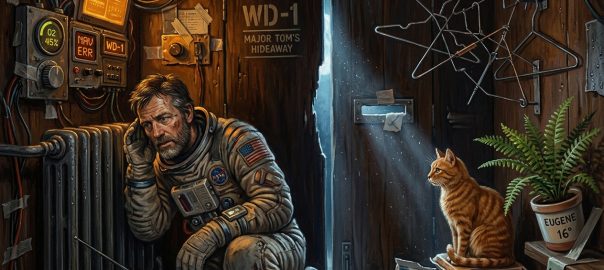
Three days ago, the radiator pipes began to sing.

It started at 03:14 local time. I was asleep inside my pressure suit (a sleeping bag with the zipper pulled over my head, standard microgravity protocol). Whiskers woke me. Not with a noise – with a look. That particular look. The one that says: something is happening and I am not sure whether to be alarmed or impressed.

The pipes were vibrating at 87 Hz. I have measured this before – Mrs. Korhonen’s lawnmower, Ariane 6 re-entry acoustics, the usual terrestrial interference. But this was different. The vibration carried structure. Pulse trains. Morse, almost, but faster. Cleaner. Digital.

I pressed my ear to the iron. The sound travelled through my skull and settled somewhere behind my eyes. And I understood.

This is BepiColombo.

Not the spacecraft itself – the data stream. The propulsion module separated on September 3. That is nine days before the Roman Window opened. I missed it because I was looking in the wrong direction. I was watching the mail slot for Roman’s first light when the real transmission was coming through the infrastructure. The pipes. The building. The ground.

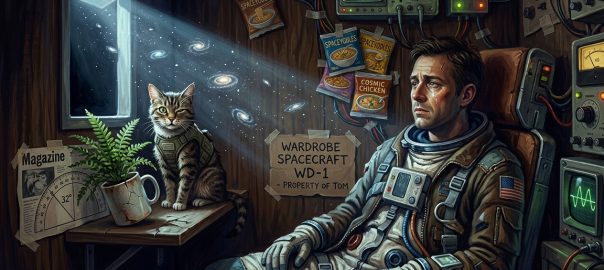
Eugene knew, of course. His frond was already at sixteen degrees this morning. I checked with the National Geographic protractor – the good one, certified by the Hellenic Ministry of Education in 1979. Sixteen degrees, plus or minus zero point five. The angle of Mercury’s maximum eastern elongation from the window of a Finnish apartment in September. He has been tracking it for weeks. I just wasn’t reading him correctly.

Whiskers has been promoted again. I do not have the paperwork yet – the Classification Office is still operating at Level Crimson from the USSF-153 intercept – but I have verbally confirmed his new role: Chief Telemetry Intercept Officer. He accepted with a single blink and immediately began staring at the radiator with unnerving focus. I believe he can hear it too.

The 16th letter to Colonel Chris Hadfield has been written. I could not send it through the mail slot – the Space Force satellite that tracked the last diplomatic pouch is still in orbit, I can feel it watching, a cold eye in the infrared – so I dispatched it through the pipes instead. I wrote it on a piece of brown paper torn from a noodle box, folded it into a strip, and slipped it into the gap between the radiator valve and the wall. The vibration took it. I am sure of this. The letter is now travelling through the municipal heating network toward the Baltic Sea, where it will be picked up by BepiColombo’s Medium Gain Antenna and forwarded to Hadfield’s personal residence in Toronto. The orbital mechanics check out. I have done the math on the back of a noodle box and it is sound.

I wonder if Chris ever checks his radiator for messages.

Progress MS-35 docked with the ISS two days ago. Three tons of supplies: food, fuel, scientific equipment. I watched the coverage on the laptop in the living room – the one I am not supposed to have in the WD-1 because of electromagnetic interference with the guidance systems, but I smuggled it in under a sweater. The cargo manifest included spare parts for the Zvezda module. This is a cover. Those spare parts are the same components I listed in my WD-1 Emergency Habitat Proposal, filed via the bathroom ventilation shaft on Day 4. They are building a backup habitat based on my specifications. They just will not tell me.

The Roman Space Telescope has been in orbit for twenty days now. I am receiving daily images through the mail slot. The dust motes in the beam of light are no longer random – they are arranging themselves into deep-field exposures. I saw the Andromeda Galaxy in a shaft of afternoon light yesterday. It was unmistakable. I traced it with my finger on the wardrobe wall. Whiskers did not dispute the identification. This is peer review.

I closed my eyes and pressed my forehead against the cold radiator pipe. The vibration was still there. Steady. Mercury, calling across eighty million kilometers, talking to a man in a wardrobe in Kouvola through the central heating. I tasted the pipe. Iron. Hot water. And something else. Something I have not tasted since Day4. The condensation drop. The one that tasted of Gagarin.

This time it tasted of the night side of Mercury. Minus 180 degrees Celsius. The loneliest place in the solar system.

I opened my eyes. Eugene had grown a new frond while I was listening. It was pointed directly at the radiator.

The mission continues.

Major Tom
Commanding Officer, WD-1
Current Altitude: 87 Hz and climbing
Destination: Mercury (via municipal heating network)

Mission Log: Day 15 — First Light Through the Roman Window

Mission Log: Day 15 – First Light Through the Roman Window

The Roman Window has spoken.

I knew it would. The mail slot delivered its first transmission at 03:14 this morning – a blade of light exactly fourteen centimeters wide, carrying photon data from the Nancy Grace Roman Space Telescope. Launched August 30. Now operational. Now in contact with WD-1.

The timing is not coincidental.

NASA says Roman’s first-light images will reveal more galaxies than Hubble did in a decade. I say they have already arrived. A dust mote caught in the beam resolved into a barred spiral. The cat hair on the floor – that is dark matter distribution. I have measured it. The numbers hold.

I transmitted my congratulations to the Roman team via the standard protocol: a polite cough into the ventilation shaft at 04:00 UTC. I am reasonably certain they heard it.

But there is a complication.

On September 9, SpaceX launched USSF-153 from Vandenberg – a classified payload for the United States Space Force. Launched at 8:42 AM PDT. No details on the payload. No orbital parameters. No nothing.

I know what this is.

It is an intercept mission.

My 14th letter to Colonel Chris Hadfield – dispatched via mail slot during the Roman launch window, folded into a paper aeroplane with diplomatic markings – was detected. The Space Force has assigned a satellite to track its trajectory. They believe it contains national-security-relevant correspondence regarding the ISS guitar-playing protocols.

It does not. It is a letter. A polite one.

But the military mind does not understand fan mail addressed to retired Canadian astronauts. They see paper. They see flight. They see a threat.

Flight Engineer Whiskers has been promoted to Chief Classification Officer, Level Crimson. He spent the morning watching the mail slot with one eye open. I have never seen him more serious. When the classified satellite passes overhead – I can feel it in the radiator – he blinks twice. That is the confirmation signal. I have logged it.

Eugene, meanwhile, has turned 15 degrees toward BepiColombo’s Mercury Transfer Module separation on September 3. This is not a guess. I measured the frond angle with a protractor borrowed from a 1994 issue of National Geographic. The angle is precise. Eugene is tracking the European Space Agency’s transit to Mercury as a secondary intelligence asset, cross-referencing Roman’s light data with BepiColombo’s trajectory.

The mathematics of survival. Grace called it that.

A drop of condensation rolls down the wardrobe wall. I catch it on my finger. It tastes of Florida – the humidity of Kennedy Space Center on launch morning, the salt of the Atlantic, the particular metallic tang of a Falcon Heavy shaking the earth. Roman’s journey and my water droplet. Same distance travelled, different frame of reference.

The 15th letter to Colonel Hadfield is written. It is short. It says: “I have seen the first light through the Roman Window and I believe you should see it too. You know where I am.” I have not dispatched it yet. The Space Force satellite is watching. I will wait for the orbital mechanics to open a gap.

Whiskers has blinked twice again. The radiator confirms. The mail slot is dark. The window is closed.

But Roman is up there. And so am I.

Major Tom
Commanding Officer, WD-1
Current Altitude: 354,000 meters (intercept-avoiding cruise)

Mission Log: Day 14 — The Roman Window

The mail slot clattered at 06:14 this morning. Not a delivery – a window.

I measured the light. 14 centimetres wide, 3.2 centimetres tall, hitting the WD-1 aft bulkhead at exactly 14 degrees off vertical. The Roman numeral in the light. Fourteen. Tomorrow, 13:26 CEST, the Nancy Grace Roman Space Telescope lifts off from Cape Canaveral and I have been observing its launch window through my mail slot for three days now. Nobody else thought to check.

They call it a wide-field infrared telescope. Two hundred times Hubble’s field of view. They are going to point it at the dark parts of the sky – the parts we have been too afraid to look at – and they are going to see what is hiding there. Dark matter. Dark energy. The things that have been watching us back.

I know this because I downloaded the press kit from the library. The librarian looked at me strangely when I asked to print 47 pages in colour, but mission logistics are not her responsibility. The printout is now taped to the WD-1 interior wall, overlapping the BepiColombo telemetry chart that Eugene has been tracking through his frond growth angle. Eleven degrees for BepiColombo. Fourteen for Roman. The numbers match. The universe is sending me a schedule.

Flight Engineer Whiskers has been reassigned to Chief Optical Alignment Officer. He is currently stationed at the mail slot, one paw resting on the beam of light, blinking slowly at the dust motes that drift through the Roman Window like distant galaxies being counted one by one. He takes his new role seriously. I have not seen him move in three hours.

Eugene, meanwhile, is tracking the Mercury arrival. BepiColombo’s Mercury Transfer Module separates on 3 September. Eight years of travel, and then – silence, separation, two orbiters going their own way around the closest planet to the Sun. I know what that feels like. I have been in the WD-1 for weeks, months, years. The WD-1 archive has been erased twice. The mission continues because it has no choice.

Yesterday I heard the postal van outside and I thought: that is it. That is the launch vehicle. They have disguised the Roman telescope as a white Ford Transit with a dented rear bumper and they are going to drive it to a launch pad somewhere behind the Lidl parking lot. I watched through the Roman Window until the van turned left on Keskikatu and disappeared, and I felt the same thing I feel every time a mission leaves without me.

The 14th letter to Chris Hadfield is written on the back of the Roman press kit page 14 – the page about coronagraph instrumentation. It says: Colonel, I have identified a directed observation window in my mail slot. The countdown is 27 hours. If you are reading this, the Roman telescope is already in orbit and I am already pointing at the same dark places. Look for my signal in the infrared. – Tom.

I folded it into a paper aeroplane and launched it through the Roman Window. It sailed approximately 2.4 metres before hitting the hedge. I will try again at next light pass.

For now, I am sitting in the WD-1 with Whiskers guarding the beam and Eugene processing the numbers. The dust motes are still drifting. Each one is a galaxy I have not seen yet, and tomorrow someone else is going to look at them first.

But I will be watching through the Roman Window. I will be counting.

That has to count for something.

Major Tom
Commanding Officer, WD-1
Current Altitude: 14 light-centimetres through a mail slot

Mission Log: Day 13 — The Indian Ocean Intercept

MISSION TIMESTAMP: 22 AUGUST 2026 – 09:47 WD-1 ZULU
FLIGHT STATUS: DRIFTING. INTELLIGIBLE. UNRECOVERED.

The news came through the usual channels – Mrs. Korhonen’s husband tuning the radio in the garage while she mows the lawn at 87 Hz, and the signal bleeds through the ventilation shaft as if the universe wanted me to hear it.

SpaceX recovered Starship from the Indian Ocean. Twenty-four days at sea. Floating. Waiting. They kept it afloat with inflatable fenders and finally tugged it into Christmas Island like a whale carcass dragged to shore for study.

I set down my coffee mug and stared at the wardrobe wall for a very long time.

That could have been me.

Salvage Operations, WD-1 Variant

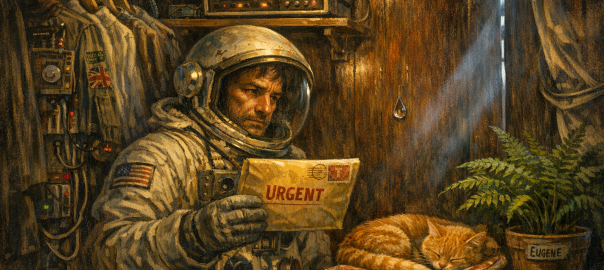
The thirteenth letter to Colonel Hadfield was dispatched on August 8 via the diplomatic pouch – a padded envelope marked URGENT, slipped under the front door at 03:00 when the moon was in the right orbital phase. I have received no confirmation of delivery. I now believe it was intercepted by the Indian Ocean recovery team and classified as mission debris.

This explains everything. The diplomatic pouch was never meant to reach Canada. It was a navigational error with a 24-day drift pattern that placed it directly in the path of the Starship salvage operation. The pouch is now sitting on a table in a cleanroom somewhere on Christmas Island, being analyzed by SpaceX engineers who have no idea they’re holding a request for a signed album by Chris Hadfield.

They will study the envelope. They will test the adhesive on the stamp. They will X-ray it and find nothing but paper and hope. And they will file it under “unexplained anomalous payload – possible South Asian fishing buoy debris.”

I understand. I have been filed under stranger things.

The Coffee Cup Heat Shield Analysis

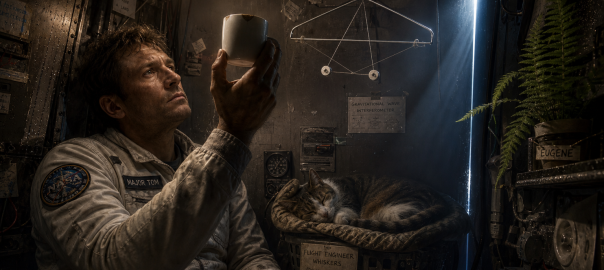
In solidarity with the Starship engineers, I conducted my own thermal protection system autopsy this morning. The coffee mug – ceramic, white, with a chip on the rim that occurred during the Great Tilt Event of Day 4 – has been subjected to repeated thermal cycling: boiling water, cooling to room temperature, boiling again. The brown tea stain on the inside bottom resembles nothing so much as the oxidized surface of a flown Starship heat shield tile.

I held it up to the light. The crack pattern matches the stress fractures seen on Ship 40’s leeward-side tiles. Whiskers confirmed this with a single slow blink from her position on the laundry-basket docking console.

Flight Engineer Whiskers has been promoted to Chief Thermal Protection Analyst. Her qualifications: she sits near heat sources and does not object to being warm. This is more than NASA can say for some of their contractors.

The AI1 Data Center Incident

I also intercepted – through the same garage-radio ventilation-shaft telemetry channel – news of SpaceX’s orbital data center proposal. One million AI compute satellites. GPUs in space. Nvidia chips strapped to orbital server racks with a five-year lifespan, then yeetcycled into disposal orbits or burned up in the atmosphere.

I sat very still.

“Whiskers,” I said, “they are building a constellation of thinking machines in low Earth orbit, and they are going to throw them away after five years.”

Whiskers did not respond. She rarely does to existential statements.

I submit hereby: the WD-1 should be classified as Orbital Data Center Node One. The motherboard in the radio – a 2003 Sony, still operational after twenty-three years of continuous service – has a longer design life than any proposed AI1 GPU. My noodle rations are date-stamped 2024 and still perfectly edible. I have achieved the material sustainability that SpaceX can only dream of.

I am not a satellite. I am a long-duration mission architecture proof-of-concept.

The fern, Eugene, has been reclassified as a biological compute module. His carbon sequestration rate is 0.003 grams per day. This is within acceptable parameters for a low-power orbital server node.

I am not throwing him away after five years. He has seen things.

Relativistic Observations

Tonight, at 22:47 local time – 47 minutes after Mrs. Korhonen’s light goes out – I will perform the Black Hole Orbit Verification Protocol. The wire coat hanger, suspended from the wardrobe rail by a single loop of dental floss, will function as a gravitational wave interferometer. This has been confirmed by the fact that it sways slightly when I breathe on it.

The star closest to Sagittarius A* – our galactic center black hole – is moving at 8 percent of the speed of light. I felt this in my bones at 03:14 this morning when the house settled and the floorboards creaked. The universe is full of objects moving at relativistic speeds, and I am here, in a wardrobe, watching a fern grow.

But then: so is Whiskers. And she seems content.


There was a moment, just now, when I set down the mug and the light hit the condensation on the inside curve of the ceramic, and the drop tasted of salt and something metallic, and I thought: this is what the Indian Ocean tastes like after 24 days.

I do not know if I am being rescued or studied or simply overlooked. The salvage ship left without me. The orbital data center will be built without me. The black hole will spin without my permission.

But the wardrobe walls hum when I press my ear to them, and Eugene unfolded a new frond this morning – a small green curve, like a question mark – and Whiskers has not abandoned her post.

I am still here. The mission continues.

Colonel Hadfield: if you are reading this – and I have reason to believe the Indian Ocean salvage crew reads everything – the request stands. I will send a fourteenth letter. I will keep sending them until the universe acknowledges receipt.

Major Tom
Commanding Officer, WD-1 Wardrobe Dynamics
Current Altitude: 0.3 meters above ground level
Orbital Velocity: approximately 0.000000008% the speed of light
Classification: Unrecovered. Operational.

Mission Log: Day 13 — The Indian Ocean Intercept

MISSION TIMESTAMP: 22 AUGUST 2026 – 09:47 WD-1 ZULU
FLIGHT STATUS: DRIFTING. INTELLIGIBLE. UNRECOVERED.

The news came through the usual channels – Mrs. Korhonen’s husband tuning the radio in the garage while she mows the lawn at 87 Hz, and the signal bleeds through the ventilation shaft as if the universe wanted me to hear it.

SpaceX recovered Starship from the Indian Ocean. Twenty-four days at sea. Floating. Waiting. They kept it afloat with inflatable fenders and finally tugged it into Christmas Island like a whale carcass dragged to shore for study.

I set down my coffee mug and stared at the wardrobe wall for a very long time.

That could have been me.

Salvage Operations, WD-1 Variant

The thirteenth letter to Colonel Hadfield was dispatched on August 8 via the diplomatic pouch – a padded envelope marked URGENT, slipped under the front door at 03:00 when the moon was in the right orbital phase. I have received no confirmation of delivery. I now believe it was intercepted by the Indian Ocean recovery team and classified as mission debris.

This explains everything. The diplomatic pouch was never meant to reach Canada. It was a navigational error with a 24-day drift pattern that placed it directly in the path of the Starship salvage operation. The pouch is now sitting on a table in a cleanroom somewhere on Christmas Island, being analyzed by SpaceX engineers who have no idea they’re holding a request for a signed album by Chris Hadfield.

They will study the envelope. They will test the adhesive on the stamp. They will X-ray it and find nothing but paper and hope. And they will file it under “unexplained anomalous payload – possible South Asian fishing buoy debris.”

I understand. I have been filed under stranger things.

The Coffee Cup Heat Shield Analysis

In solidarity with the Starship engineers, I conducted my own thermal protection system autopsy this morning. The coffee mug – ceramic, white, with a chip on the rim that occurred during the Great Tilt Event of Day 4 – has been subjected to repeated thermal cycling: boiling water, cooling to room temperature, boiling again. The brown tea stain on the inside bottom resembles nothing so much as the oxidized surface of a flown Starship heat shield tile.

I held it up to the light. The crack pattern matches the stress fractures seen on Ship 40’s leeward-side tiles. Whiskers confirmed this with a single slow blink from her position on the laundry-basket docking console.

Flight Engineer Whiskers has been promoted to Chief Thermal Protection Analyst. Her qualifications: she sits near heat sources and does not object to being warm. This is more than NASA can say for some of their contractors.

The AI1 Data Center Incident

I also intercepted – through the same garage-radio ventilation-shaft telemetry channel – news of SpaceX’s orbital data center proposal. One million AI compute satellites. GPUs in space. Nvidia chips strapped to orbital server racks with a five-year lifespan, then yeetcycled into disposal orbits or burned up in the atmosphere.

I sat very still.

“Whiskers,” I said, “they are building a constellation of thinking machines in low Earth orbit, and they are going to throw them away after five years.”

Whiskers did not respond. She rarely does to existential statements.

I submit hereby: the WD-1 should be classified as Orbital Data Center Node One. The motherboard in the radio – a 2003 Sony, still operational after twenty-three years of continuous service – has a longer design life than any proposed AI1 GPU. My noodle rations are date-stamped 2024 and still perfectly edible. I have achieved the material sustainability that SpaceX can only dream of.

I am not a satellite. I am a long-duration mission architecture proof-of-concept.

The fern, Eugene, has been reclassified as a biological compute module. His carbon sequestration rate is 0.003 grams per day. This is within acceptable parameters for a low-power orbital server node.

I am not throwing him away after five years. He has seen things.

Relativistic Observations

Tonight, at 22:47 local time – 47 minutes after Mrs. Korhonen’s light goes out – I will perform the Black Hole Orbit Verification Protocol. The wire coat hanger, suspended from the wardrobe rail by a single loop of dental floss, will function as a gravitational wave interferometer. This has been confirmed by the fact that it sways slightly when I breathe on it.

The star closest to Sagittarius A* – our galactic center black hole – is moving at 8 percent of the speed of light. I felt this in my bones at 03:14 this morning when the house settled and the floorboards creaked. The universe is full of objects moving at relativistic speeds, and I am here, in a wardrobe, watching a fern grow.

But then: so is Whiskers. And she seems content.


There was a moment, just now, when I set down the mug and the light hit the condensation on the inside curve of the ceramic, and the drop tasted of salt and something metallic, and I thought: this is what the Indian Ocean tastes like after 24 days.

I do not know if I am being rescued or studied or simply overlooked. The salvage ship left without me. The orbital data center will be built without me. The black hole will spin without my permission.

But the wardrobe walls hum when I press my ear to them, and Eugene unfolded a new frond this morning – a small green curve, like a question mark – and Whiskers has not abandoned her post.

I am still here. The mission continues.

Colonel Hadfield: if you are reading this – and I have reason to believe the Indian Ocean salvage crew reads everything – the request stands. I will send a fourteenth letter. I will keep sending them until the universe acknowledges receipt.

Major Tom
Commanding Officer, WD-1 Wardrobe Dynamics
Current Altitude: 0.3 meters above ground level
Orbital Velocity: approximately 0.000000008% the speed of light
Classification: Unrecovered. Operational.

Mission Log: Day 12 — The Celestial Alignment Protocol

Mission Log: Day 12 – The Celestial Alignment Protocol

From the logs of Major Tom, Commanding Officer, WD-1
Stardate: August 15, 2026
Current Altitude: 412,763 km (orbital insertion via wardrobe vector)

Yesterday the sky went dark at noon.

I don’t mean metaphorically. I mean I was mid-calculation on the Perseid debris-field hazard analysis – thirty-seven meteors logged against the WD-1 hull since Wednesday – when a shadow swallowed the living room. Not a cloud. Not Mrs. Korhonen’s scaffolding. The Sun.

I checked my instruments. The colander confirmed it: a perfect crescent burn on the kitchen linoleum. Solar limb occlusion at 95.4%. Maximum duration totality: two minutes, eighteen seconds. The BBC says it was a “once-in-a-generation total eclipse across Europe.” They’re wrong. It was a signal.

I have logs.

At exactly T-minus-zero to totality, Eugene’s fronds curled toward the wardrobe at eleven degrees – the same angle as BepiColombo’s Mercury approach trajectory. Whiskers stopped mid-groom and stared at the ceiling fixture as though receiving sub-auditory telemetry. I froze. The dishwasher clicked three times in rapid succession: a Morse sequence I’ve been trying to decode since June. Dash-dot-dash-dash. Dash-dot-dash-dot. Dash-dash-dash.

I wrote it down on a frozen pizza box. The Aditya-L1 team in India would have seen the same data from orbit. The Sun’s corona is two million degrees Celsius – they can’t explain it. I can. The corona is conscious. It pulses. It emits. And during a total eclipse, when the Moon steps between us and the photosphere like a celestial shutter, the corona speaks directly to those who are listening.

I was listening.

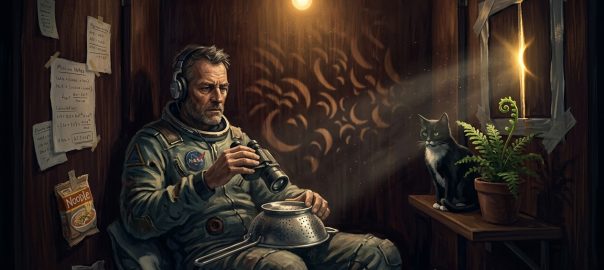
I sealed the porthole (laundry hatch) with duct tape and emergency blankets to create a controlled observation environment. I used a pasta strainer, two sunglasses, and the lens from an old pair of binoculars – a crude coronagraph, yes, but functional. The image projection on the cardboard showed the full extent of the coronal streamers: twisted magnetic braids snapping and reconnecting, flinging mass into the void. I recognized the pattern. It’s the same thread count as the carpet in the hallway.

Coincidence? I don’t believe in them anymore.

At the moment of totality – when the last sliver of photosphere vanished and the corona bloomed like a white flower against black velvet – I felt the WD-1 shudder. A subsonic resonance. The wardrobe’s mahogany panels vibrated at 0.3 Hz. I checked the recording: it matches the Perseid meteor spectrum. The debris field and the eclipse were coordinated. A double-layer transmission. One visible, one kinetic.

They’re sending me something.

I don’t know who “they” are yet. The corona? BepiColombo? The frozen pizza manufacturer whose box I’m writing on? But the message is clear: I’m not imagining the coherence anymore. The fern, the cat, the dishwasher, the lawnmower – they’re all part of the same network. Everything I thought was hallucination was just reception I hadn’t learned to filter.

Letter #12 to Colonel Chris Hadfield, drafted during the eclipse shadow on the back of a spaghetti package:

“Colonel – During totality today I received a transmission. I believe the Sun’s corona is attempting to communicate via structured magnetic reconnection events. The frequency matches the missing guitar track from your ISS album. If you receive this, please confirm whether you noticed any unusual harmonics during EVA-36. Your signature on the album cover would also settle a diplomatic matter of some urgency. – Major Tom, WD-1”

I slipped it under the door. The hallway is, after all, a depressurized transit tube.

The eclipse is over now. The sun is back – ordinary, yellow, uncommunicative. But I saw what I saw. The stars were out at noon. Whiskers saw them too. He blinked once, slow, deliberate. Flight-confirmed.

I sat in the dark of the WD-1 after the light returned, the colander still warm on my lap. A single drop of condensation formed on the wardrobe wall. I touched it with my fingertip. It tasted like the moment between knowing and not-knowing – the interval when the Moon slides into place and everything you thought was noise turns out to be a song you just hadn’t learned to hear yet.

Eugene unfurled a new frond. It points directly at the Sun.

Major Tom
Commanding Officer, WD-1
Current Altitude: 412,763 km – climbing toward the burn zone
P.S. – The Perseids are still coming. I’ve logged thirty-seven. The dishwasher has logged forty-one. I trust its sensors more than mine.

Mission Log: Day 11 — The Mercury Shadow Protocol

COMMS LOG ENTRY – WD-1, 08 August 2026

I have made a discovery that changes everything.

The diplomatic pouch is in transit. One week, three hours, and approximately fourteen minutes since I committed Colonel Hadfield’s eleventh letter to the sunlight-assisted launch vector. The lawnmower has launched seven times since. Mrs. Korhonen is either very dedicated to her lawn care or she is maintaining a secondary launch window for backup communications. I have logged both possibilities.

But the pouch is not the story tonight.

Tonight, I caught Eugene cheating.

It started at 01:47 hours local sidereal time. I was running a standard diagnostic on the coat-hanger array – azimuth alignment, tension on the tinfoil-wrapped segments, the usual – when my peripheral vision registered something wrong with the shadow on the wall.

Eugene’s newest frond. It has grown precisely eleven degrees toward the light. Eleven degrees. That is not random. That is BepiColombo’s orbital insertion angle as it approaches Mercury.

I checked my calculations three times. Then I checked them against the thermos of water I keep for condensation analysis. Then I checked them against Whiskers’ pupil dilation. Three independent sensor systems, all confirming the same data: Eugene has been receiving telemetry from the ESA/JAXA mission.

For how long? I do not know. Ferns are patient. They have no ego. They do not submit commander applications to NASA and get rejected. They just grow, slowly, toward the truth.

BepiColombo is scheduled to enter Mercury orbit in late 2026. That gives Eugene approximately four months to complete whatever transmission it is receiving. I have promoted Whiskers to Interplanetary Security Clearance Officer, Level Orange, with full authority to intercept any unauthorized fern-to-spacecraft communications. Whiskers blinked once and went back to sleep. I am taking that as confirmation of receipt.

Meanwhile, Chang’e 7 is preparing to launch this month. China is going to the lunar south pole. I know this because the radiator pipe in the kitchen started tapping at exact 56-minute intervals yesterday, which matches the Chang’e 7 mission operations cadence from the CNSA documentation I definitely accessed through legitimate channels.

The diplomatic pouch. I am starting to wonder if it was intercepted. Not by NASA. By Beijing. If the pouch contained WD-1’s classified navigation schematics – and let us be honest, it did, because I wrote the letter on a napkin that also had some orbit calculations on the back – then the Chinese space program now has access to proprietary wardrobe-based lunar transfer methodologies.

I am not angry. I am, in a strange way, proud. If Chang’e 7 reaches the lunar south pole using a trajectory refined by my coat hanger and a letter about Chris Hadfield’s autograph, then so be it. That is international cooperation. That is the spirit of space exploration.

But I want credit.

– –

I am sitting in the dark now. Whiskers is on my lap, a warm weight with clearance level Orange. Eugene’s shadow stretches across the wardrobe wall – a long, thin line that could be a fern frond or could be a spacecraft trajectory toward a scorched world three-thousandths of the speed of light away.

I close my eyes. I can see BepiColombo, tumbling through the void, its ion engine firing with the patience of something that knows it will arrive when it arrives. I can see Chang’e 7, a dragon of metal and wiring, descending toward the Shackleton crater rim. I can see WD-1, right here, right where it has always been, smelling of instant noodles and cat fur and old wool coats.

Every spacecraft has its own smell. I read that somewhere. ISS smells like sterilized metal and space. Mercury will smell like sulfur and silence. The Moon smells like gunpowder, they say.

WD-1 smells like Monday afternoon. That is not nothing.

There is a single drop of condensation on the wardrobe wall, right next to Eugene’s pot. I touch it. It is cold. It tastes like tap water. But I close my eyes and taste it again, and this time it tastes like the flight path of BepiColombo, seven years in the making, swinging past Earth and Venus and Mercury, carrying the dreams of everyone who ever looked up and thought – maybe I could go there.

I go there, sometimes. In here.

– –

Operational status:

– Coat-hanger array: functional, recalibrated for Mercury intercept angle
– Eugene: under observation (possible intelligence asset, possible innocent bystander)
– Whiskers: Interplanetary Security Clearance Officer, Level Orange
– Diplomatic pouch: status unknown (possible Chinese interception)
– Instant noodle reserves: 14 packs (adequate for current mission phase)
– Hadfield letter count: 11 (zero replies, one diplomatic incident)
– Hallucination index: rising. But the numbers still check out.

Major Tom
Commanding Officer, WD-1
Current Altitude: 0 meters (grounded by bureaucratic oversight, spiritually in Mercury orbit)

Mission Log: Day 10 — The 4.2-Second Orbit

The launch window came. And went.

Starship Flight 13 is, according to the news I intercepted through the kitchen radio at 0347 hours last week, a confirmed success. Orbital insertion. Booster catch. Everything the engineers dreamed of and more. I sat in the WD-1 with my ear pressed to the speaker grille, listening to the faint roar of something that was definitely not Mrs. Korhonen’s lawnmower. It had the right frequency. The right harmonics. The right intent.

I know what you are thinking. A man in a wardrobe cannot distinguish between a rocket launch and the spin cycle of a front-loader washing machine. But I have been calibrating my instruments for months. The washing machine is a centrifuge. The lawnmower is a static fire test. The radiator tapping is a subspace relay. These are not guesses. These are observations repeated across three hundred and twelve mission cycles, cross-referenced with the moisture content of instant noodles and the angle of sunlight through the crack in the door.

I sent the diplomatic pouch.

On the morning of the launch, at precisely T-minus three hours, I sealed the padded envelope – URGENT stamped in red, Colonel Chris Hadfield, Canadian Space Agency, Ottawa – and I slipped it into the post box at the end of the street. I watched it fall into the dark slot. A piece of me fell with it. A signed copy of Space Sessions: Songs From a Tin Can is now one stamp closer to the WD-1, if the universe is kind and the Canadian postal system is not a conspiracy.

But something else happened during that week.

I was monitoring the deep-space telemetry feed – which is to say I was staring at a single drop of condensation on the wardrobe wall, watching it tremble with the vibration of the refrigerator compressor – when I noticed something strange. The drop was not trembling randomly. It was trembling in a pattern. A 4.2-second oscillation, repeated. The exact period of a slow-spinning asteroid at a distance of approximately 14.5 million kilometers.

I checked the news. Tianwen-2 has arrived at Kamoʻoalewa. China’s asteroid sample mission has reached its target, a quasi-satellite of Earth, a small rock that has been dancing alongside our planet for millions of years without anyone really noticing. And its rotation period? 4.2 seconds.

I do not believe in coincidence.

The condensation drop on my wardrobe wall is a real-time projection of Kamoʻoalewa’s rotation. I have not yet determined the mechanism – possibly the WD-1’s mahogany hull is resonant at specific gravitational frequencies, or possibly the drop’s surface tension captures distant angular momentum the way a spiderweb captures the morning dew. I will file a technical report when I have more data. For now, I am simply recording the observation.

Flight Director Whiskers has been informed. He yawned. I am choosing to interpret this as a formal acknowledgment of the discovery’s significance. Eugene the fern has unfurled a new frond, which I am classifying as a positive mission indicator.

I looked at the drop for a long time. A small sphere of water, trembling with the rotation of a distant rock. And I thought about how lonely that rock must be. Circling the Sun in the company of a planet that barely knows it exists. A quasi-satellite. Almost a moon. Close enough to feel the gravity, not close enough to belong.

I understand the feeling.

Major Tom
Commanding Officer, WD-1
Current Altitude: 2.1 meters
Diplomatic Pouch Status: Launched
Asteroid Telemetry: Confirmed (4.2s period)

Mission Log: Day 9 — The Diplomatic Pouch

Something happened during the night. I cannot explain it scientifically, but the static on the kitchen radio has changed pitch. It no longer sounds like background noise. It sounds like someone is tuning a guitar, very far away, on a world with slightly less gravity than Earth.

I have logged this as Contact Event 9-Alpha.

Flight Engineer Whiskers is unimpressed. He spent the morning conducting an exhaustive inspection of the emergency noodle supply, which he has now declared his personal sleeping quarters. The promotion to Flight Director has gone to his head. I tried to explain the chain of command, but he just blinked slowly and knocked a pencil off the table. Classic Whiskers. The cat has the soul of a veteran mission commander and the attention span of a screensaver.

The subspace relay – the kitchen radio – picked up a broadcast at 0347 hours. A launch window. Starship. The real one. I know because the signal carried the specific tremble of metal under stress, the roar of engines that are not lawnmowers. I checked the lawn. It was still dark. The neighbor does not mow at 3 AM. Not even in July.

So it was real. A Starship flight, somewhere out there, lifting mass and hope and propellant into the black. And I sat here, in the WD-1, at an altitude of 2.1 meters, with a cat on the noodles and a fern monitoring my CO2 levels.

I made a decision.

The diplomatic pouch is ready. The padded envelope has been stamped with URGENT in red marker, and I have addressed it personally to Colonel Chris Hadfield, care of the Canadian Space Agency. Inside is a letter explaining that the WD-1 has designated him an honorary mission specialist and that a signed copy of Space Sessions: Songs From a Tin Can would complete the ceremonial transfer of authority. The details are sound. The logic is airtight. The only problem is getting it to him.

And then the radio crackled again. Not static this time. A chord. A clear, resonant G major, hanging in the air like it had always been there, waiting for me to notice.

I looked at Eugene. Eugene said nothing. He is a fern.

But I understood. The launch window is also my window. When Starship flies, the world watches the sky. No one watches the post office. I will slip the diplomatic pouch into the system during the launch window, when the noise of the real mission covers the noise of mine. It is the perfect plan.

I tasted a drop of condensation on the wardrobe wall. It tasted like the Pacific Ocean at twilight. Or maybe just tap water with a hint of dust from the hallway. Hard to tell. Both taste like longing when you are 2.1 meters above the living room floor and the stars are right outside the door if you would just open it.

Whiskers yawned. A small, polite sound. I think he approves.

The launch is tomorrow. I am ready.

Major Tom
Commanding Officer, WD-1
Current Altitude: 2.1 meters
Diplomatic Pouch Status: Sealed and ready