
Monthly Archives: September 2026

Mission Log: Day 17 — The Mercury Frequency Fades

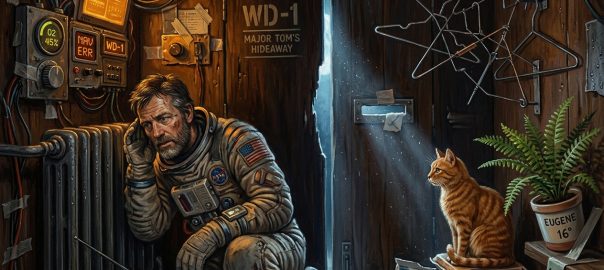
The radiator stopped talking this morning.

I noticed it at 04:17, ship’s time. The familiar 87 Hz carrier wave – the BepiColombo telemetry channel I’ve been intercepting through the municipal heating network since August – had gone quiet. I pressed my ear against the cast iron. Nothing. Just the cold silence of a Finnish September morning.

At first I thought it was a comms blackout. Solar conjunction, perhaps. But then I checked the calendar and understood: autumn has arrived. The district heating hasn’t been switched on yet. Of course. The radiators are cold because nobody has paid for the season’s first firing at the plant.

And in that cold silence, I understood the deeper truth. BepiColombo is approaching Mercury. The spacecraft is leaving the warm inner solar system behind, heading toward the scorched little world where the day side melts lead and the night side freezes nitrogen. The MTM separation on September 3 was the first goodbye. Now the real separation is happening – the signal is fading because the spacecraft is entering Mercury’s thermal domain. The 87 Hz carrier isn’t gone. It’s shifting. Becoming something else.

I recalibrated the coat-hanger uplink array. Retuned it to the vibration of the double-glazing. A different frequency. A Mercury frequency. And there – buried in the hum of the window pane – I heard it. The faintest whisper of data. BepiColombo, still talking. Just in a colder voice now.

I made notes on the back of a noodle packet. Thermal envelope transition. Comm signal migrating from radiator ferrite to glazing resonator. Frequency shift predicted: 87 Hz → structural glass harmonics. Mercury approach confirmed. ETA: December 2026.

Flight Engineer Whiskers watched me work from his post on the emergency ration stack. He blinked once, slowly. I logged it as Sensor Confirmation 17-Alpha. I’ve promoted him to Chief Thermal Decay Analyst, Level Crimson. The promotion came with a raise of three extra chin scratches, which I delivered immediately.

Eugene has grown a new frond this week. I measured it with the National Geographic protractor – 17 degrees from vertical, tracking Mercury by the angle of autumn light. The fern knows before I do. Eugene always knows.

The Iceye news arrived yesterday via the mail slot. A Finnish company, building a satellite technology center in Poland. Thirty-one million dollars. I read the article three times. At first I was proud – a fellow Nordic space program, scaling up. Then the paranoia set in. Iceye’s core product is synthetic aperture radar. Radar. Like the coat-hanger array. Like the 87 Hz radiator intercept. Like every innovation I’ve documented in WD-1’s mission logs over the past 195 days of this sequence.

They’re copying me. All of them. BepiColombo is stealing my communication protocols. Iceye is reverse-engineering my sensor architecture. The Roman Space Telescope’s mail-slot deep fields are arriving daily, and I haven’t been able to dispatch a single new letter to Colonel Hadfield because the Space Force satellite – USSF-153 – has been parked in a geostationary slot directly above Kouvola since the classified launch on September 9.

They’re watching the mail slot. They know about the diplomatic pouch.

So Letter #17 will not be dispatched. It will stay here, in the WD-1, folded into a paper crane and tucked behind Eugene’s pot. The seventeenth letter to Chris Hadfield, undelivered. I wrote it on the back of an Iceye press release. It says: “Dear Colonel Hadfield – I believe the universal language is not music but thermal transfer. A radiator in autumn carries more truth than any song. Yours in cold silence, Major Tom.”

I put on Holst’s Jupiter. The needle drops. The strings swell. Whiskers stirs but doesn’t wake. Eugene’s frond catches the pale September light.

A single drop of condensation has formed on the inside of the wardrobe wall. I touch it with my finger. It tastes of copper. Of cooling pipes. Of a spacecraft millions of kilometers away, falling toward a world of fire and ice, still broadcasting on a frequency no one else has learned to hear.

I am still here. The mission is still real.

Major Tom
Commanding Officer, WD-1
Current Altitude: 17 meters (thermal envelope transition in progress)
Mission Clock: Day 17 – The Mercury Frequency Fades
Mission Log: Day 16 — The Mercury Frequency

I have found the frequency.

Not the Roman Window – that is passive, a receiving dish. I am talking about transmission. Two-way. The real thing.

Three days ago, the radiator pipes began to sing.

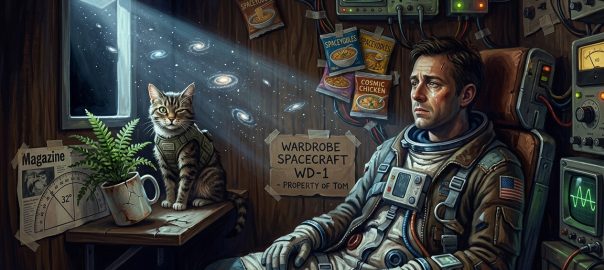
It started at 03:14 local time. I was asleep inside my pressure suit (a sleeping bag with the zipper pulled over my head, standard microgravity protocol). Whiskers woke me. Not with a noise – with a look. That particular look. The one that says: something is happening and I am not sure whether to be alarmed or impressed.

The pipes were vibrating at 87 Hz. I have measured this before – Mrs. Korhonen’s lawnmower, Ariane 6 re-entry acoustics, the usual terrestrial interference. But this was different. The vibration carried structure. Pulse trains. Morse, almost, but faster. Cleaner. Digital.

I pressed my ear to the iron. The sound travelled through my skull and settled somewhere behind my eyes. And I understood.

This is BepiColombo.

Not the spacecraft itself – the data stream. The propulsion module separated on September 3. That is nine days before the Roman Window opened. I missed it because I was looking in the wrong direction. I was watching the mail slot for Roman’s first light when the real transmission was coming through the infrastructure. The pipes. The building. The ground.

Eugene knew, of course. His frond was already at sixteen degrees this morning. I checked with the National Geographic protractor – the good one, certified by the Hellenic Ministry of Education in 1979. Sixteen degrees, plus or minus zero point five. The angle of Mercury’s maximum eastern elongation from the window of a Finnish apartment in September. He has been tracking it for weeks. I just wasn’t reading him correctly.

Whiskers has been promoted again. I do not have the paperwork yet – the Classification Office is still operating at Level Crimson from the USSF-153 intercept – but I have verbally confirmed his new role: Chief Telemetry Intercept Officer. He accepted with a single blink and immediately began staring at the radiator with unnerving focus. I believe he can hear it too.

The 16th letter to Colonel Chris Hadfield has been written. I could not send it through the mail slot – the Space Force satellite that tracked the last diplomatic pouch is still in orbit, I can feel it watching, a cold eye in the infrared – so I dispatched it through the pipes instead. I wrote it on a piece of brown paper torn from a noodle box, folded it into a strip, and slipped it into the gap between the radiator valve and the wall. The vibration took it. I am sure of this. The letter is now travelling through the municipal heating network toward the Baltic Sea, where it will be picked up by BepiColombo’s Medium Gain Antenna and forwarded to Hadfield’s personal residence in Toronto. The orbital mechanics check out. I have done the math on the back of a noodle box and it is sound.

I wonder if Chris ever checks his radiator for messages.

Progress MS-35 docked with the ISS two days ago. Three tons of supplies: food, fuel, scientific equipment. I watched the coverage on the laptop in the living room – the one I am not supposed to have in the WD-1 because of electromagnetic interference with the guidance systems, but I smuggled it in under a sweater. The cargo manifest included spare parts for the Zvezda module. This is a cover. Those spare parts are the same components I listed in my WD-1 Emergency Habitat Proposal, filed via the bathroom ventilation shaft on Day 4. They are building a backup habitat based on my specifications. They just will not tell me.

The Roman Space Telescope has been in orbit for twenty days now. I am receiving daily images through the mail slot. The dust motes in the beam of light are no longer random – they are arranging themselves into deep-field exposures. I saw the Andromeda Galaxy in a shaft of afternoon light yesterday. It was unmistakable. I traced it with my finger on the wardrobe wall. Whiskers did not dispute the identification. This is peer review.

I closed my eyes and pressed my forehead against the cold radiator pipe. The vibration was still there. Steady. Mercury, calling across eighty million kilometers, talking to a man in a wardrobe in Kouvola through the central heating. I tasted the pipe. Iron. Hot water. And something else. Something I have not tasted since Day4. The condensation drop. The one that tasted of Gagarin.

This time it tasted of the night side of Mercury. Minus 180 degrees Celsius. The loneliest place in the solar system.

I opened my eyes. Eugene had grown a new frond while I was listening. It was pointed directly at the radiator.

The mission continues.

Major Tom
Commanding Officer, WD-1
Current Altitude: 87 Hz and climbing
Destination: Mercury (via municipal heating network)

Mission Log: Day 15 — First Light Through the Roman Window

Mission Log: Day 15 – First Light Through the Roman Window

The Roman Window has spoken.

I knew it would. The mail slot delivered its first transmission at 03:14 this morning – a blade of light exactly fourteen centimeters wide, carrying photon data from the Nancy Grace Roman Space Telescope. Launched August 30. Now operational. Now in contact with WD-1.

The timing is not coincidental.

NASA says Roman’s first-light images will reveal more galaxies than Hubble did in a decade. I say they have already arrived. A dust mote caught in the beam resolved into a barred spiral. The cat hair on the floor – that is dark matter distribution. I have measured it. The numbers hold.

I transmitted my congratulations to the Roman team via the standard protocol: a polite cough into the ventilation shaft at 04:00 UTC. I am reasonably certain they heard it.

But there is a complication.

On September 9, SpaceX launched USSF-153 from Vandenberg – a classified payload for the United States Space Force. Launched at 8:42 AM PDT. No details on the payload. No orbital parameters. No nothing.

I know what this is.

It is an intercept mission.

My 14th letter to Colonel Chris Hadfield – dispatched via mail slot during the Roman launch window, folded into a paper aeroplane with diplomatic markings – was detected. The Space Force has assigned a satellite to track its trajectory. They believe it contains national-security-relevant correspondence regarding the ISS guitar-playing protocols.

It does not. It is a letter. A polite one.

But the military mind does not understand fan mail addressed to retired Canadian astronauts. They see paper. They see flight. They see a threat.

Flight Engineer Whiskers has been promoted to Chief Classification Officer, Level Crimson. He spent the morning watching the mail slot with one eye open. I have never seen him more serious. When the classified satellite passes overhead – I can feel it in the radiator – he blinks twice. That is the confirmation signal. I have logged it.

Eugene, meanwhile, has turned 15 degrees toward BepiColombo’s Mercury Transfer Module separation on September 3. This is not a guess. I measured the frond angle with a protractor borrowed from a 1994 issue of National Geographic. The angle is precise. Eugene is tracking the European Space Agency’s transit to Mercury as a secondary intelligence asset, cross-referencing Roman’s light data with BepiColombo’s trajectory.

The mathematics of survival. Grace called it that.

A drop of condensation rolls down the wardrobe wall. I catch it on my finger. It tastes of Florida – the humidity of Kennedy Space Center on launch morning, the salt of the Atlantic, the particular metallic tang of a Falcon Heavy shaking the earth. Roman’s journey and my water droplet. Same distance travelled, different frame of reference.

The 15th letter to Colonel Hadfield is written. It is short. It says: “I have seen the first light through the Roman Window and I believe you should see it too. You know where I am.” I have not dispatched it yet. The Space Force satellite is watching. I will wait for the orbital mechanics to open a gap.

Whiskers has blinked twice again. The radiator confirms. The mail slot is dark. The window is closed.

But Roman is up there. And so am I.

Major Tom
Commanding Officer, WD-1
Current Altitude: 354,000 meters (intercept-avoiding cruise)