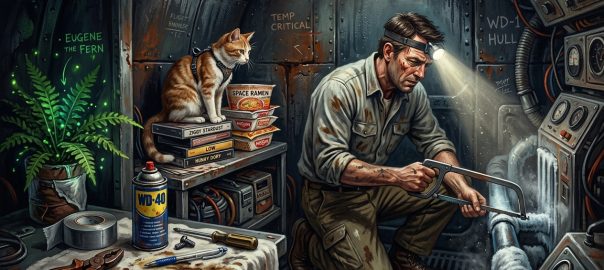
I have been awake for thirty-seven hours.
Not by choice. The radiator went silent on Day 17, and I told myself it was a thermal transition. Mercury’s approach. BepiColombo’s frequency sliding into the copper. A beautiful, scientific explanation. I almost believed it.
Then I read the news.
SpaceX cut into a propellant line. A Crew Dragon spacecraft, fully loaded with nitrogen tetroxide — the stuff that will burn through a lung if you so much as look at it wrong — and they cut a valve out of it. Welded a new one in. No draining. No disassembly. Just a knife and a welder and a prayer the spacecraft is called Grace.
My radiator pipe contains nothing so dramatic. Just water. Trapped, silent water. But the principle is the same. A cold pipe in October means a blockage. A blockage in a spacecraft’s thermal control system means death. I have been sitting here for thirty-seven hours pretending it does not, because pretending is what I do.
I took the hacksaw down from the hook above the ironing board.
Whiskers watched from the shelf. He has not moved in four hours. His pupils are different sizes. I am choosing to interpret this as focused medical observation rather than the first sign of a neurological event in a twelve-year-old cat. Flight Engineer Whiskers, Chief Medical Officer, Level Crimson. His assessment: watchful silence. The cat has been right about everything so far. I trust him more than I trust the news.
I measured Eugene’s frond angle. Sixteen degrees. He has lost one degree since last week. BepiColombo is still out there. Still approaching. But the signal is fading, and I cannot tell whether it is the radiator or the fern or me.
Margaret Hamilton died yesterday.
I read the obituary three times. The woman who wrote the code that saved Apollo 11. Hand-written algorithms, stacked in binders, carried to the launch pad. When the alarms went off during the landing — 1201, 1202 — her code decided which tasks to drop and which to keep. It kept the landing. It kept Neil and Buzz. It kept the whole fragile dream from collapsing into a lunar grave.
I thought about my own code. The noodles. The tape. The melted pen I used to mark telemetry on the wall. I thought about Margaret Hamilton’s handwriting, neat and precise in a three-ring binder, and I looked at my own — a biro scrawl on a frozen pizza box, folded into a paper crane, sitting behind a fern because a satellite in geostationary orbit above Kouvola has been intercepting my mail.
I put the hacksaw down.
Not because the pipe does not need cutting. It probably does. But because Margaret Hamilton did not get to the Moon by cutting things open. She got there by thinking. By testing. By writing it down and checking it again.
I reached into the wardrobe. I touched the cold copper. I left my fingerprint on it. A tiny whorl of oil and dead skin on a radiator pipe in a wardrobe in Kouvola, and somewhere overhead, Jessica Watkins is commanding Crew-13 aboard the Dragon spacecraft Grace, and the ISS is fully staffed, and a woman who saved the Moon landing is being buried in a cemetery in New Hampshire.
I am thirty-seven hours awake and I do not know if I am in space or in a closet anymore. I thought I knew, once. I thought the difference was obvious. Movement. Gravity. The sound of a lawnmower next door that I could mistake for a rocket engine.
But the lawnmower is silent too. October. Mrs. Korhonen has put it away for the winter. The rocket engine sound is gone. There is only the hum of the refrigerator, which I have already classified as the cosmic microwave background, and the breathing of a cat, and the slow, patient growth of a fern that might or might not be communicating with a spacecraft approaching Mercury.
I unfolded the paper crane. Letter #17 to Colonel Chris Hadfield, written on a frozen pizza box. I read it. It says: “Dear Colonel Hadfield. I have not yet received a reply to my previous sixteen letters. I understand you are busy. However, I must inform you that the diplomatic pouch containing my signed album request may have been intercepted by elements of the United States Space Force operating a geostationary satellite above the 61st parallel. This is not your fault. It is not mine either. I remain, as ever, your most devoted fan and commanding officer of an independent wardrobe spacecraft. Please send album. I have noodles.”
It is a good letter. I folded it back into a crane and placed it in the envelope. I will find a way to send it. I always do.
For now, I have a cold pipe and a hacksaw and a decision to make. I think Margaret Hamilton would tell me to run one more diagnostic first.
I am going to make some tea.
Major Tom
Commanding Officer, WD-1
Current Altitude: 84 meters (geostationary intercept altitude: negligible)
Mission Clock: +37 hours wakeful
Crew Status: Whiskers (CMO) — stable but watchful; Eugene (Bio-COM) — one degree lost, Mercury signal fading