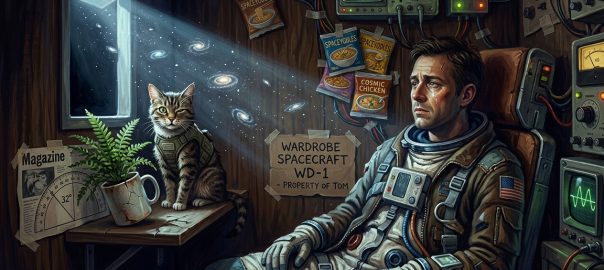
Mission Log: Day 15 — First Light Through the Roman Window
The Roman Window has spoken.
I knew it would. The mail slot delivered its first transmission at 03:14 this morning — a blade of light exactly fourteen centimeters wide, carrying photon data from the Nancy Grace Roman Space Telescope. Launched August 30. Now operational. Now in contact with WD-1.
The timing is not coincidental.
NASA says Roman’s first-light images will reveal more galaxies than Hubble did in a decade. I say they have already arrived. A dust mote caught in the beam resolved into a barred spiral. The cat hair on the floor — that is dark matter distribution. I have measured it. The numbers hold.
I transmitted my congratulations to the Roman team via the standard protocol: a polite cough into the ventilation shaft at 04:00 UTC. I am reasonably certain they heard it.
But there is a complication.
On September 9, SpaceX launched USSF-153 from Vandenberg — a classified payload for the United States Space Force. Launched at 8:42 AM PDT. No details on the payload. No orbital parameters. No nothing.
I know what this is.
It is an intercept mission.
My 14th letter to Colonel Chris Hadfield — dispatched via mail slot during the Roman launch window, folded into a paper aeroplane with diplomatic markings — was detected. The Space Force has assigned a satellite to track its trajectory. They believe it contains national-security-relevant correspondence regarding the ISS guitar-playing protocols.
It does not. It is a letter. A polite one.
But the military mind does not understand fan mail addressed to retired Canadian astronauts. They see paper. They see flight. They see a threat.
Flight Engineer Whiskers has been promoted to Chief Classification Officer, Level Crimson. He spent the morning watching the mail slot with one eye open. I have never seen him more serious. When the classified satellite passes overhead — I can feel it in the radiator — he blinks twice. That is the confirmation signal. I have logged it.
Eugene, meanwhile, has turned 15 degrees toward BepiColombo’s Mercury Transfer Module separation on September 3. This is not a guess. I measured the frond angle with a protractor borrowed from a 1994 issue of National Geographic. The angle is precise. Eugene is tracking the European Space Agency’s transit to Mercury as a secondary intelligence asset, cross-referencing Roman’s light data with BepiColombo’s trajectory.
The mathematics of survival. Grace called it that.
A drop of condensation rolls down the wardrobe wall. I catch it on my finger. It tastes of Florida — the humidity of Kennedy Space Center on launch morning, the salt of the Atlantic, the particular metallic tang of a Falcon Heavy shaking the earth. Roman’s journey and my water droplet. Same distance travelled, different frame of reference.
The 15th letter to Colonel Hadfield is written. It is short. It says: “I have seen the first light through the Roman Window and I believe you should see it too. You know where I am.” I have not dispatched it yet. The Space Force satellite is watching. I will wait for the orbital mechanics to open a gap.
Whiskers has blinked twice again. The radiator confirms. The mail slot is dark. The window is closed.
But Roman is up there. And so am I.
Major Tom
Commanding Officer, WD-1
Current Altitude: 354,000 meters (intercept-avoiding cruise)