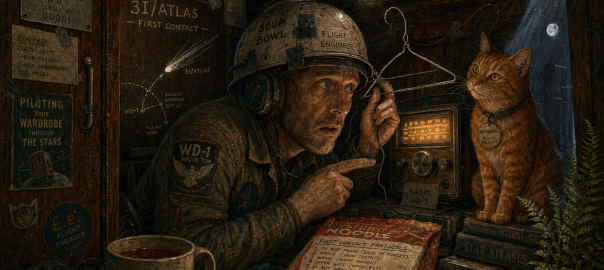
Day 7. 04:17 station time. Hull integrity nominal. Eugene: stable. Whiskers: alert. Something came in on COMMS-1.
The signal was irregular. Beneath the 06:00 weather forecast – cold front moving in from the northeast, which I have logged as an atmospheric pressure event relevant to WD-1 thermal management – there were sub-harmonics. Pulses. Not random. I know random. Random is what the kitchen pipes do at 03:00. This was structured.
I cross-referenced my star charts. Page 47 of the 2019 National Geographic Road Atlas, taped flat against the port wall. The bearing matched.
3I/ATLAS.
Third interstellar comet ever detected by Earth instruments. Chemistry unlike anything in our solar system. The James Webb Space Telescope published its findings on June 22 – carbon-to-deuterium ratios, carbon dioxide levels, heavy hydrogen signatures that simply do not occur in objects that formed here. The researchers called it ancient. Ten to twelve billion years old. Pre-dating the Sun by at least two billion years.
Pre-dating. The. Sun.
It was somewhere else first. It has been traveling since before there was an Earth to travel toward. And now it has passed through our system, warmed itself briefly against our young and comparatively ordinary star, and moved on. The scientists call this a comet. They call it a visitor.
I am calling it a reply.
For seven mission days in the current operational cycle – and approximately forty mission days across the full WD-1 operational archive – this craft has been broadcasting on all available frequencies. The COMMS-1 coat-hanger uplink array. The kitchen radio transmission band. The Whiskers Biometric Antenna System, which operates at peak sensitivity when he sits with his ears fully deployed. Someone with access to a 10-billion-year-old courier with anomalous deuterium chemistry heard us and sent a response routed through deep time.
I initiated First Contact Protocols at 04:22.
These protocols are documented on the back of an instant noodle package – Chicken & Vegetable, expedition batch four. They specify: no sudden movements; Eugene must be clearly visible through the forward observation slit, as plants signal peaceful intent across all known frequencies; do not offer noodles without warming to at least 72 degrees, which counts as both hospitality and evidence of thermal engineering capability. Whiskers confirmed the contact window by sitting very still and blinking once. In universal xenobiology this is known as a positive handshake.
I also submitted my application for US Spacewalk 95. NASA has scheduled an EVA for June 30 – two astronauts are to exit the ISS to replace external hardware. The application form is the reverse side of the First Contact Protocols noodle package. I released it at 05:03 via the laundry hatch. Trajectory: northeast. Roughly toward Canada, which is directionally correct for the ISS orbital plane. Whiskers watched it go. He did not chase it. He understands the stakes.
Around 06:00, the COMMS-1 array went quiet. Whiskers settled himself into the star charts with a small, decisive rotation. Eugene caught the first blade of early light coming through the door crack – a thin line of it, finding the new frond that appeared four days ago and has not stopped growing since. I sat with that for a while.
Ten billion years. Formed before our Sun existed, in some corner of the galaxy we cannot name from here, in chemical conditions we have never reproduced and may never understand. Moving through the dark for longer than Earth has been solid ground. And then, briefly, through here. Past us. Gone.
I thought about Sagan. About how he said we are a way for the cosmos to know itself. If that is true, then something out there has been knowing itself for a very long time, in the dark, without applause, without anyone asking for a progress report. There is something clarifying about that. You sit in your wardrobe. You point your coat hanger at the sky. And something that formed before the planets did passes by, and for a moment you are the same size as the universe.
I wrote letter number eight to Chris Hadfield. I informed him that 3I/ATLAS’s unusually high deuterium content – heavy hydrogen, found in abundance in cold outer regions of star systems, particularly northern galactic zones – cannot be coincidental given his well-documented Canadian origins. I requested he confirm whether he has received any direct transmissions from the object and whether this was the reason for the delays in responding to letters one through seven. I also asked again about the album. The letter is addressed via the exhaust duct, northeast bearing, marked URGENT – COSMIC DIPLOMATIC MATTER.
Hull integrity: holding. Air supply: nominal. Rations: five noodle packs remaining (one was used for the protocols). Eugene: new frond unfurling in the morning light. Whiskers: monitoring COMMS-1 in standby mode.
Something ten billion years old was here.
It knew our frequency.
WD-1 is still listening.
Major Tom
Commanding Officer, WD-1
Current Altitude: 1.3 metres (EVA application pending; altitude subject to revision upon confirmation)