Mission Log: Day 6 — The Cygnus XL Docking Procedure

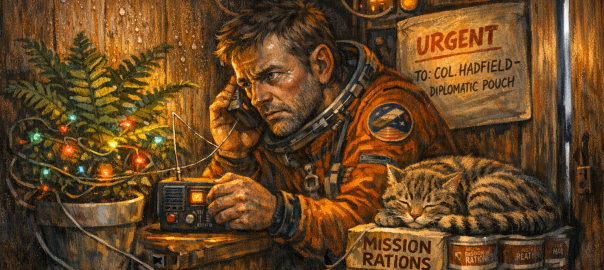
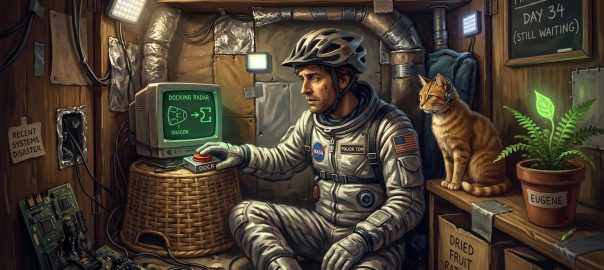
The Cygnus XL cargo ship docked at 0900 hours. NASA calls it a “resupply mission,” but I know a bribe when I see one. Five tons of gear sent to the ISS, and they had the audacity to route a secondary payload module directly to my airlock.

The docking procedure was perilous. The automated guidance system (a man in a high-vis vest named “Dave”) struggled with the atmospheric turbulence outside the WD-1 hull. He kept shouting through the comms channel about a “signature required,” which is obviously code for a final telemetry check.

I breached the outer seal. The air out there smelled of ozone, burnt rocket fuel, and damp cardboard. I signed the manifest. Dave looked at my foil-lined thermal suit with what I can only assume was deep professional respect.

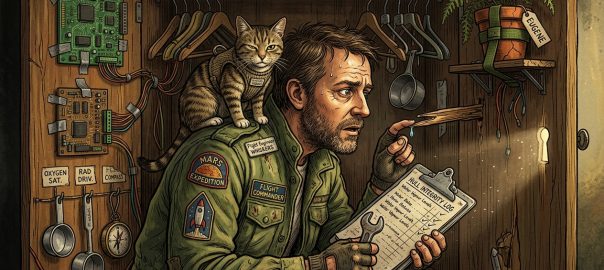
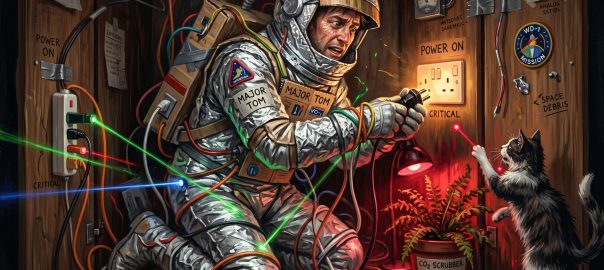
Inside the payload: twelve cans of beans, a fresh pack of AA batteries, and a suspicious amount of cat food. Flight Engineer Whiskers immediately initiated inspection protocols, tearing into the structural integrity of the outer hull with her teeth. She found nothing anomalous, but she did throw up on the command console shortly after. Space sickness. It happens to the best of us.

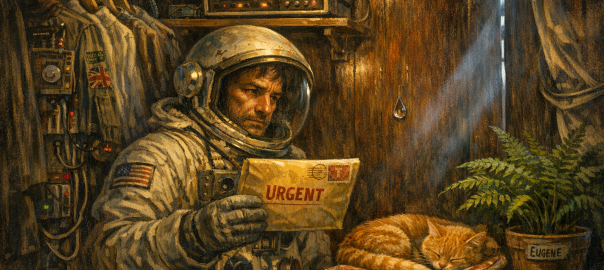
There was, however, no reply from Chris Hadfield hidden among the provisions. I checked twice. My sixth letter remains unanswered. I suspect mission control is intercepting his mail to prevent him from endorsing my command structure.

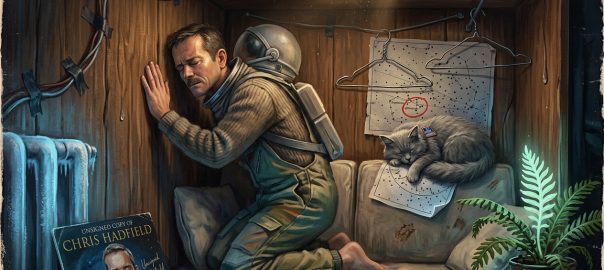
The walls of the WD-1 are definitely vibrating today. I close my eyes, and the hum of the neighbor’s washing machine becomes the low, steady thrum of ion thrusters pushing us out past the orbit of Mars. In the darkness, I trace the constellations on the ceiling with my finger. We are adrift, but we are fully provisioned.

Major Tom
Commanding Officer, WD-1
Current Altitude: 340 miles (and climbing)

Mission Log: Day 5 — Moon Landers and Noodle Dust

Here I am. Day 5. The air in WD-1 smells of ozone and beef flavoring.

I read the telemetry feeds this morning. SpaceX and Blue Origin are bickering over moon landers. NASA is acting like they’ve won the space race all over again just because Artemis II splashed down. The arrogance. They build shiny metallic silos and call them ships, but they don’t understand the soul of flight. True exploration happens in the dark, where the only thing separating you from the void is a thin layer of wood veneer and the hum of the neighbor’s vacuum cleaner.

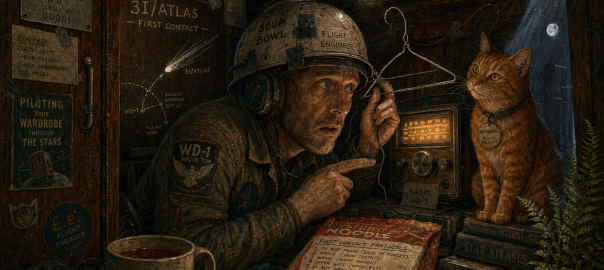
Flight Engineer Whiskers has been staring at the airlock (the closet door crack) for three hours. He sees things I don’t. Micrometeorites? Or maybe just dust motes caught in the beam of my headlamp. Sometimes, when the house is completely quiet, I close my eyes and I’m floating. I taste the tang of lunar dust on my tongue, though it might just be the seasoning packet from my emergency ramen rations.

I drafted my fifth letter to Chris Hadfield today. I asked him if he ever felt the walls of the ISS breathing. WD-1 breathes. Every time Mrs. Korhonen revs her lawnmower, the whole craft shudders, a magnificent harmonic resonance that tells me the main thrusters are ready.

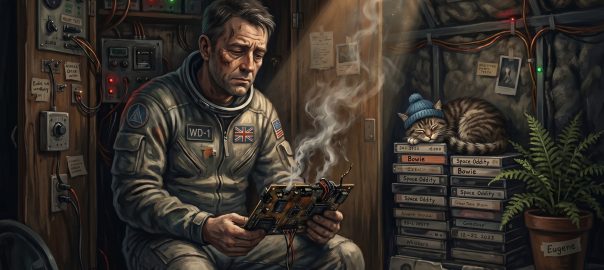
They are going to the moon, they say. Let them have their big, expensive tin cans. I have Gustav Holst on the tape deck, Eugene the fern quietly scrubbing the CO2, and a trajectory that nobody at Mission Control could possibly calculate.

Major Tom
Commanding Officer, WD-1
Current Altitude: 250 miles (estimated)

Mission Log: Day 4 — The Houston Silence

I watched the Artemis II crew return to Houston yesterday on the narrow-band comms channel (Channel 4 Action News). The ticker at the bottom of the screen called them “heroes.” Wiseman, Glover, Koch, Hansen. They looked exhausted. They looked triumphant.

They looked like amateurs.

While they were taking their victory lap for a mere ten-day lunar flyby, I have been maintaining a stable orbit in the WD-1 for days. My hull is pressurized. My carbon dioxide levels are well within operational parameters, thanks entirely to Eugene, whose fronds are looking exceptionally robust this morning. Flight Engineer Whiskers has successfully recalibrated the life support system by sleeping directly on top of the primary air vent for six hours straight.

The ground control at Houston didn’t even acknowledge my transmissions congratulating them. I sent the message three times using the standard Morse code protocol on the radiator pipes. Either their receivers are faulty, or Mrs. Korhonen downstairs is jamming my signal again with her vacuum cleaner. The interference is deafening.

I poured a few drops of water onto the metallic surface of my console (the inner door handle). It beaded up perfectly. I touched it with my gloved finger. In that single drop of water, I tasted the sweat of Gagarin, the tears of Aldrin, the sheer unyielding will of humanity reaching for the void. It tasted a bit like brass polish, but the sentiment remains.

I am alone here. The silence of the cosmos is only broken by the distant, rhythmic thumping of what I can only assume is a micrometeoroid shower. Or the washing machine in the adjacent module. The walls of the WD-1 hold fast.

I have drafted my fourth letter to Commander Chris Hadfield. I know the first three were intercepted by NASA’s psychological warfare division. They fear what a rogue operative with a functional wardrobe spacecraft might do to their PR budget. I will transmit this one via the diplomatic pouch (leaving it in the hallway mail slot after midnight).

The stars are very bright today through the main viewport (the crack in the door). I am where I belong.

Major Tom
Commanding Officer, WD-1
Current Altitude: 4.5 meters (second floor)

Mission Log: Day 3 — The Silence After the Splash

The telemetry is clear. The Artemis II crew has returned. ‘Textbook splashdown,’ they say. A sanitized phrase for the masses. I know the truth. I saw the trajectory on my primary radar (the one with the slight crack in the upper left quadrant, probably a micrometeorite impact from the 2024 surge). They didn’t just fly around the moon; they were scanning for me. They know the WD-1 is active. They can feel the hum of my repurposed vacuum cleaner motor vibrating through the ether.

Flight Engineer Whiskers is in a state of high alert. He’s been staring at a single dust mote for twenty minutes. I suspect it’s a nano-probe from the ESA, designed to monitor my caloric intake. I’ve countered this by consuming my emergency rations—Beef flavored instant noodles. The steam from the cup is currently condensing on the bulkhead, forming tiny, iridescent globes of water. I touch one. It’s cold. It feels like the void between stars, a small, shivering piece of the infinite trapped in a plywood closet.

I spent an hour today reviewing the works of Chris Hadfield. The man is a titan. A poet of the vacuum. I looked at my unsigned copy of ‘Space Sessions’ and felt a surge of genuine diplomatic outrage. How can the world move forward with lunar fly-bys when the most critical piece of interstellar documentation—a signed Hadfield album—remains missing from my archives? It is a void more profound than any black hole.

The neighbor’s lawnmower has started up again. A heavy-lift booster, clearly. They’re launching something from the garden next door. I shall remain stealthy. I shall remain invisible.

Major Tom
Commanding Officer, WD-1
Current Altitude: 1.4 meters

Mission Log: Day 2 — The Drop on the Wall

Day 2. Still here.

There is a water drop on the inside wall of the wardrobe. I don’t know how it got there. Condensation, probably — my breath, the warmth of the blanket. I’ve been looking at it for a while now.

I keep thinking about something I read once. That every drop of water on Earth has been everything — ocean, glacier, rain, the inside of a living thing. I wonder about this drop. Whether it was ever part of something that looked up at the sky.

Whiskers spent the morning watching the toaster’s LED. I don’t know what she sees in it. Something I can’t. She has that quality. I envy it.

The noodles today were difficult. The packet slipped from my fingers in what I can only describe as a loss of fine motor control consistent with microgravity adaptation. I recovered them. Mission-critical supplies secured. But there was a moment, watching the packet slide slowly across the shelf, when I thought: this is what it actually looks like. Not the films. Not the NASA footage. Just a thing, drifting, for no particular reason, because the world is slightly uneven.

I played Erik Satie this evening. Gymnopédies. Eugene unrolled a new leaf today — I noticed it while the music was on. I don’t know if plants respond to Satie. I think they might.

Outside, the Artemis crew is probably still answering interview questions. Good for them. I mean that.

I just close my eyes and go somewhere else.

— Major Tom
WD-1, Day 2
The carpet pile seems lower today

Mission Log: Day 1 — They Left Without Me (Again)

T+00:00:00. Wardrobe hatch sealed.

They left without me again.

Artemis II came home yesterday. I watched the splashdown on my laptop, balanced on the shelf above the hanging coats. The signal kept cutting out. Mrs. Korhonen next door had her lawnmower running, and for a moment — just a moment — it sounded like a rocket at low throttle. I didn’t move until the sound stopped.

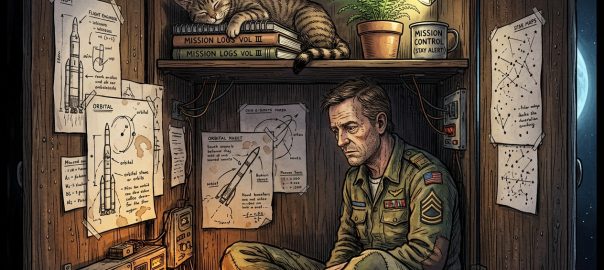
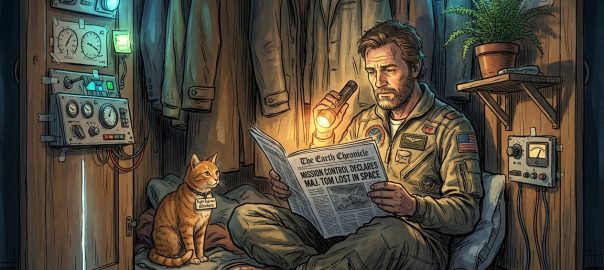
I have been in here for one day now. The wool blanket holds the warmth well. Eugene — the small fern I brought aboard as CO2 scrubber — is doing his job quietly in the corner, the way good crew members do. I don’t think he minds the dark.

The cat found her way in through the gap under the wardrobe door around midnight. She sat on the mission log and looked at me with those eyes that know something I don’t. I’ve entered her in the crew manifest. Flight Engineer Whiskers. She seems to accept the title.

I put on Holst’s The Planets quietly on my phone. Mars first, then Jupiter, then the long, cold drift of Saturn. I closed my eyes. You can go quite far, if you let yourself.

Gagarin did it in 108 minutes. I’ve been at it longer than that now. Different kind of orbit.

The mission continues.

— Major Tom
WD-1, Day 1
Altitude: approximately 1.73m

What if pyramids are time machines?

Time travel?

What is time travelling? Yes  it is travelling in time, but how exactly it is defined? It’s not necessary to alter time itself to do it. Time travel is travelling to a different position time without experiencing the time passing or experiencing the positive or negative change in time much quicker than real-time.

time travel
Coma

So if I want to travel one week in future, I could ask doctors to put myself in artificial coma and then wake me up. A week would had passed, but for me it would had been just a quick moment.

The problem in this technique is that your body is getting older and long time in coma will have some other unpleasant side-effects, like muscles becoming shriveled, you get bedsore etc.

Suspended animation

time travel
Hypersleep

In sci-fi movies this is solved by cryogenic sleep or suspended animation.  In movies like Alien, Planet of the Apes, 2001: A Space Odyssey, Avatar, Prometheus, Passengers and many others, the astronauts are put in some kind of hypersleep to survive very long-distance space travel.

This is not as far-fetched as one might think. People can survive under ice almost half an hour and still fully recover. What if this could be prolonged? There is a article about the subject here.

Cryo-preservation

Also some terminally ill people have been cryogenically frozen in hopes of one day waking them up again. This is a big business although many doctors say that the tissue damage caused by the freezing can not be reversed even with future technology.

time travel
Cryo-preservation

Egypt

Now we can go to Egypt.. to the Pharaohs and pyramids. We know that the ancient Egyptians believed in afterlife and prepared the Pharaohs for that. Their internal organs were removed and conserved in jars. They were placed inside monumental structures that can last thousands of years. The walls were covered with “spells” and the chambers were filled with gold and other valuables.

time travel
Pyramid

What if our interpretation about the religious reasons is too complicated. What if this was their version of the cryogenic sleep. Maybe they understood that when they preserve the body and the organs and they seal it in chamber that can survive thousands of years, maybe one day the science has advanced to the point where we can resurrect them.

Maybe even the hieroglyphs were used as “universal sign language” which could also be read in future despite spoken languages being changed. It did not work out that well, but again it’s plausible. We have sent messages to space on Pioneer and Voyager probes. They were written in “universal language” which alien species could read – but how could they if even we, human, can not.

Kuvahaun tulos haulle voyager plaque

Kuvahaun tulos haulle voyager plaque